 Call Us: 214-585-0050
  Find A Location
  sales@graphicInstallationteam.com
Wall and window graphics turn blank interior surfaces into a working part of your brand. A printed mural, a frosted glass film, or a bold lobby logo does three things at once: it tells visitors who you are the moment they walk in, it gives your team a space they feel proud to work in, and it guides people through a room without a single spoken word. Good office wall graphics combine the right material for the surface, a clean print, and a careful install that leaves no bubbles or peeling edges. Wall and Window Graphic Installations help bring these elements together for a polished and professional result. The use cases run the gamut, from a retail storefront window to an office hallway, a trade show booth, or a frosted privacy panel in a conference room. The payoff shows up in how a space feels and in measurable things like dwell time, foot traffic, and how often visitors mention your brand. Done right, the graphics last for years and keep paying you back. Below, we break down what they do, where they fit, which materials to pick, why install quality decides the outcome, and how to track whether the spend was worth it.
What Do Interior Graphics Actually Do for a Business?
Interior graphics do two jobs that most plain paint and drywall never touch: they shape how outsiders judge your brand, and they shift how your own people feel about coming to work. The first impression a client forms in a lobby happens in seconds, and a well-placed mural or a crisp logo behind the front desk fills those seconds with intent. Instead of a beige wall, a visitor reads color, message, and confidence.
The morale side is easy to overlook and just as real. When a team walks past walls that carry the company mission, photos of past projects, or even a fun illustrated zone, the space stops feeling rented and starts feeling owned. Studies on workplace design consistently point in the same direction: people in spaces that reflect a clear identity report feeling more connected to their work. You do not need a stat to feel it. Compare a gray cubicle farm to an office where the brand lives on the walls, and the difference is obvious the moment you step in.
There is a wayfinding payoff, too. A graphic can mark a reception area, a department, or a restroom without a single bolted sign. This kind of environmental graphics work blends branding and direction so a building reads as one connected idea rather than a pile of printed notices.
A fourth job often goes unnamed: recruiting and retention. Candidates judge a company partly on the space they interview in, and a branded office signals a business that invests in itself. Photos of a sharp interior also do quite well on a careers page or a social feed. When the walls tell the same story your pitch deck tells, the message lands as consistent rather than scattered, and that consistency is part of what builds trust before anyone shakes a hand.
Where Wall and Window Graphics Work Best
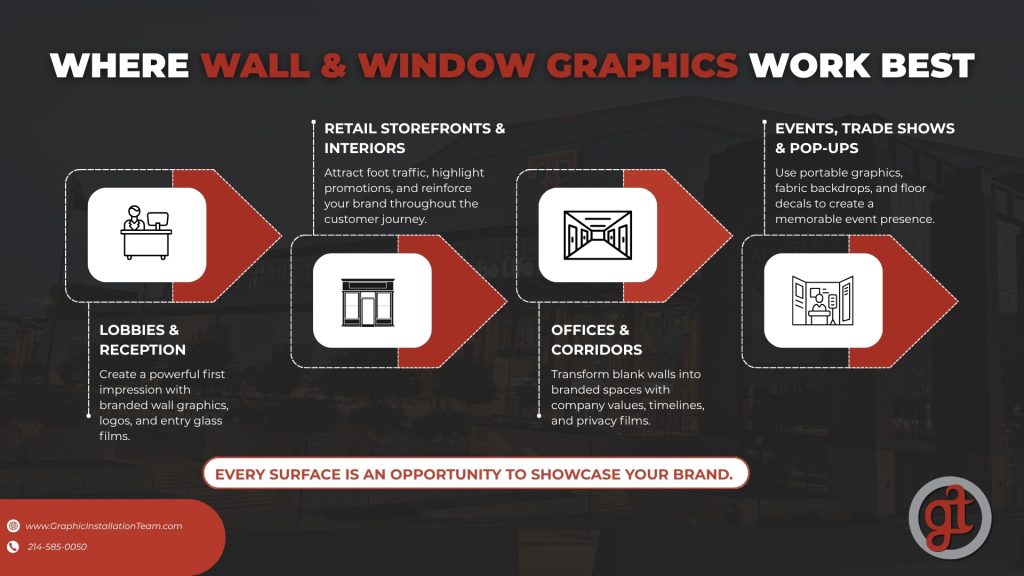
The short answer: any surface a person looks at can carry a graphic, but a handful of spaces give you the most return. Here are the common ones and what each is trying to do.
Lobbies and reception areas
The lobby is your handshake. A large-format wall logo, a dimensional sign, or a printed mural behind the desk sets the tone before anyone says hello. This is usually where companies spend the most because it earns the most attention. Pair a wall piece with subtle window film on the entry glass, and the whole arrival sequence feels designed. Sightlines matter here: the strongest lobby graphic is the one a visitor sees from the door, not one tucked behind a plant or a coat rack. Walk the room from the entrance before you commit to a spot.
Retail storefronts and interiors
Retail lives and dies on the window. Storefront window graphics pull foot traffic off the sidewalk with seasonal promos, brand imagery, or a simple bold message. Inside, retail branding graphics on walls and columns guide shoppers, mark departments, and reinforce the look you spent years building. A McKinney shop competing with national chains can stand out with strong, well-placed interior graphics that a big box store cannot match for personality. The smartest retail programs treat windows as a calendar: a back-to-school message in August, a holiday push in November, a clearance theme in January. Each swap gives you a fresh reason to catch a passing eye.
Offices and corridors
Open offices and long hallways are blank canvases. Frosted vinyl on glass meeting rooms gives privacy without killing the light. Printed walls carry values, timelines, or product imagery. Even a stairwell becomes useful real estate when it carries a clean graphic instead of scuffed paint. Long corridors are a chance to tell a story in sequence, with a timeline of company milestones or a product journey that a visitor reads as they walk. The repetition of a long hall, often seen as dead space, turns into a guided tour.
Events, trade shows, and pop-ups
Temporary spaces need graphics that go up fast and come down clean. Repositionable wall films, fabric backdrops, and floor decals build a branded booth in hours. Because these get reused, the material choice matters as much as the print. A backdrop sized for a step-and-repeat photo moment can pay for itself in shared images alone, since every attendee who poses in front of it carries your logo into their own feed.
A note on terms: a barricade graphic that wraps a construction zone in a mall, a wallpaper install in a McKinney office, and a printed feature wall all fall under the same craft. The surface and goal change, but the installation skill stays the same.
Which Materials and Finishes Should You Choose?
The right material depends on the surface, how long the graphic needs to last, and the look you want. There is no single best film, only the best fit for the job. Here is how the common options break down.
For walls, you have a few main paths:
- Smooth wall vinyl works on flat, clean, drywall and painted surfaces. It gives the crispest image and the lowest cost. It does not love heavy texture.
- Textured wall film is built to grip orange peel and knockdown drywall, the kind you find in most offices. It conforms to the texture, so the print does not flake off the high spots.
- Wallpaper and fabric wall coverings give a premium, matte feel for feature walls and high-end retail. A clean wallpaper installation in a McKinney office reads more like interior design than signage.
- Repositionable films peel and restick, which suits events and offices that rebrand often.
For glass and windows, the choices shift toward how much you want to see through:
- Clear or printed window film carries full color imagery while still letting some light through.
- Perforated window film lets people inside see out while the outside sees your graphic. Common on storefront glass.
- Frosted or etched vinyl delivers privacy and a clean, modern look in conference rooms and entry doors without blocking light.
Finishes matter too. A matte laminate kills glare in bright lobbies and photographs well. A gloss finish makes colors pop for retail. A floor-rated overlaminate adds the grip and scuff resistance a graphic needs to survive being walked on. Asking for the right finish up front saves you from a piece that looks great on day one and tired by month three.
Here is a quick way to match the common jobs to a material:
| Space and goal | Best material | Finish |
| Lobby feature wall | Smooth or textured wall vinyl | Matte to cut glare |
| Conference room privacy | Frosted or etched vinyl | Etched matte |
| Storefront promo | Perforated or printed window film | Gloss for color |
| Event backdrop | Repositionable film or fabric | Matte for photos |
| Walkable floor decal | Floor vinyl with overlaminate | Anti-slip overlaminate |
Material brand matters more than people expect. Films from trusted cast vinyl makers like 3M hold color and adhesion far longer than bargain rolls, which is why install teams certified to handle premium films are worth seeking out. A 3M preferred installer has been trained and vetted on those products, so the warranty and the finish both hold up. Cast vinyl, the kind used for premium work, is thinner and more dimensionally stable than the cheaper calendared film, which means it conforms to curves and rivets without shrinking back over time. That difference is invisible on day one and very visible a year later.
Why Surface Prep and Install Quality Make or Break the Job
The print is maybe half the result. The other half is prep and install, and this is exactly where cheap jobs fall apart. A graphic is only as good as the surface under it and the hands that apply it.
Prep starts with cleaning. Dust, fingerprints, and cleaning residue all wreck adhesion, so a good crew wipes the surface down and lets it fully dry before anything sticks. Fresh paint is a common trap: paint needs weeks to fully cure, and vinyl applied too early can lift or trap solvents.
A team that knows this will ask when the wall was painted before they schedule. Temperature plays a part, too. Vinyl applied in a cold space, below roughly 50 degrees, may not bond, and a wall that is too hot can cause the adhesive to grab before the installer can position the panel. A trained crew checks the room, not just the wall.
Then comes the install itself. Bubbles, wrinkles, lifted edges, and crooked panels are the marks of a rushed job. A skilled installer maps the layout, lines up seams so the image flows across panels, squeegees out air, and posts heat to textured film so it locks into the wall. On glass, they manage the wet or dry application so the film sits flat with no haze. These are learned skills, and the difference between a DIY attempt and a trained crew shows up in the first week. On a multi-panel mural, the hardest part is the overlap: panels need to align within a fraction of an inch, or the image breaks at the seam, and matching that across a 20-foot wall is where amateurs lose the job.
This is the part of the work we care about most. Whether the job is a retail display install, a wall and window install, or a barricade wrap, the standard is the same: tight seams, no bubbles, clean edges, and a finish that still looks sharp years later. If you want to see how this plays out across project types, our retail display installation services and wall and window pages walk through the process.
How Do You Measure the Impact of Interior Graphics?
You measure interior graphics the same way you measure any marketing spend: pick a few before and after numbers and watch them move. The catch is choosing metrics that actually connect to the goal of the space.
For retail and storefronts, track foot traffic and conversion. Count how many people walk in before and after a new window display, and watch whether sales of a featured product rise when its graphic goes up. Seasonal window swaps make this easy to test since you have a clear start date. If you run a door counter, the lift from a strong window can show up within the first week, which makes the spend easy to defend.
For lobbies and offices, the signals are softer but still real. Ask new hires and visitors what they noticed. Watch dwell time in spaces where you want people to linger. Track how often your branded wall shows up in client photos or social posts, which is free reach you did not pay for. Some companies run a quick pulse survey on whether the team feels the space reflects the brand, then compare scores before and after a refresh.
For events, the metric is usually leads and recall. Count booth visits, scans, and how many attendees mention your graphic later. A backdrop that gets photographed and shared is doing measurable work. Tag a hashtag on the backdrop, and you can count the shares directly.
The honest range here is that interior graphics rarely give you one clean number as a paid ad does. What they give you is a stack of smaller signals that all point the same way. When foot traffic ticks up, photos increase, and your team stops apologizing for the office, the graphics are working.
Ready to Put Your Brand on the Wall
A blank wall or a plain pane of glass is unused space that could be selling for you every day. The right material, a careful prep, and a clean install turn that surface into a piece of your brand people remember. If you are weighing a project for a lobby, a storefront, or an office in the McKinney area, we install across the metro and would be glad to walk the space with you. See the full range on our graphic installation team site or reach out through our McKinney installation page to start a plan.
