 Call Us: 214-585-0050
  Find A Location
  sales@graphicInstallationteam.com
Wall and window vinyl for Dallas offices means privacy frosting, lobby branding, or storefront graphics, and each one starts with a site survey and a glass-type check. Expect us to confirm whether your glass is Low-E, tinted, or an insulated unit, look hard at sun exposure on the west and south windows, and raise a permit question only for street-facing signage. As a certified install-only crew, we apply the material cleanly and on schedule. We do not design or print, so you supply finished art or work with your printer, and we handle the wall and window graphics installation from the first survey to the final squeegee.
Here’s What Most Dallas Offices Get Wrong Before They Order
Most of the pain on these projects happens before anyone touches the glass. A tenant picks a beautiful frosted pattern, orders it printed, then finds out the conference room glass is a tempered insulated unit facing due west, and the film they chose was never rated for that heat load. Or a storefront gets full-coverage vinyl, and a code officer flags it because the top two-thirds of the window has to stay clear in Dallas.
Below, we walk through the three graphics installation Dallas services businesses actually order, how your glass type changes the plan, why Texas sun exposure matters more here than most vendors admit, when a permit or landlord sign-off enters the picture, and what install day looks like room by room. The goal is simple: you should know what you are buying before the material shows up, not after.
The Three Jobs Behind “Office Vinyl” in Dallas
When a Dallas office says “we need some window vinyl,” they almost always mean one of these three, and each has its own quirks.
- Glass frosting for privacy. A translucent, etched-glass look on conference rooms, phone booths, and glass office fronts. It reads as premium, softens sightlines, and keeps daylight. This is the most common office request we see downtown and in the Uptown and Legacy corridors.
- Lobby and interior wall branding. Printed logos, murals, environmental graphics, and dimensional-look wall vinyl behind a reception desk. This is the piece that makes a visitor feel they walked into your brand, not a blank slate.
- Storefront and exterior window vinyl. Cut lettering, hours, promotional panels, and full or perforated window graphics on ground-floor retail and street-facing offices.
The reason the distinction matters: interior frosting for privacy is rarely treated as a “sign,” while street-facing lettering and promotional graphics often are, and that one difference decides whether a permit question comes up at all. We sort that out during the survey, not after your art is printed.
Why Your Glass Type Changes Everything
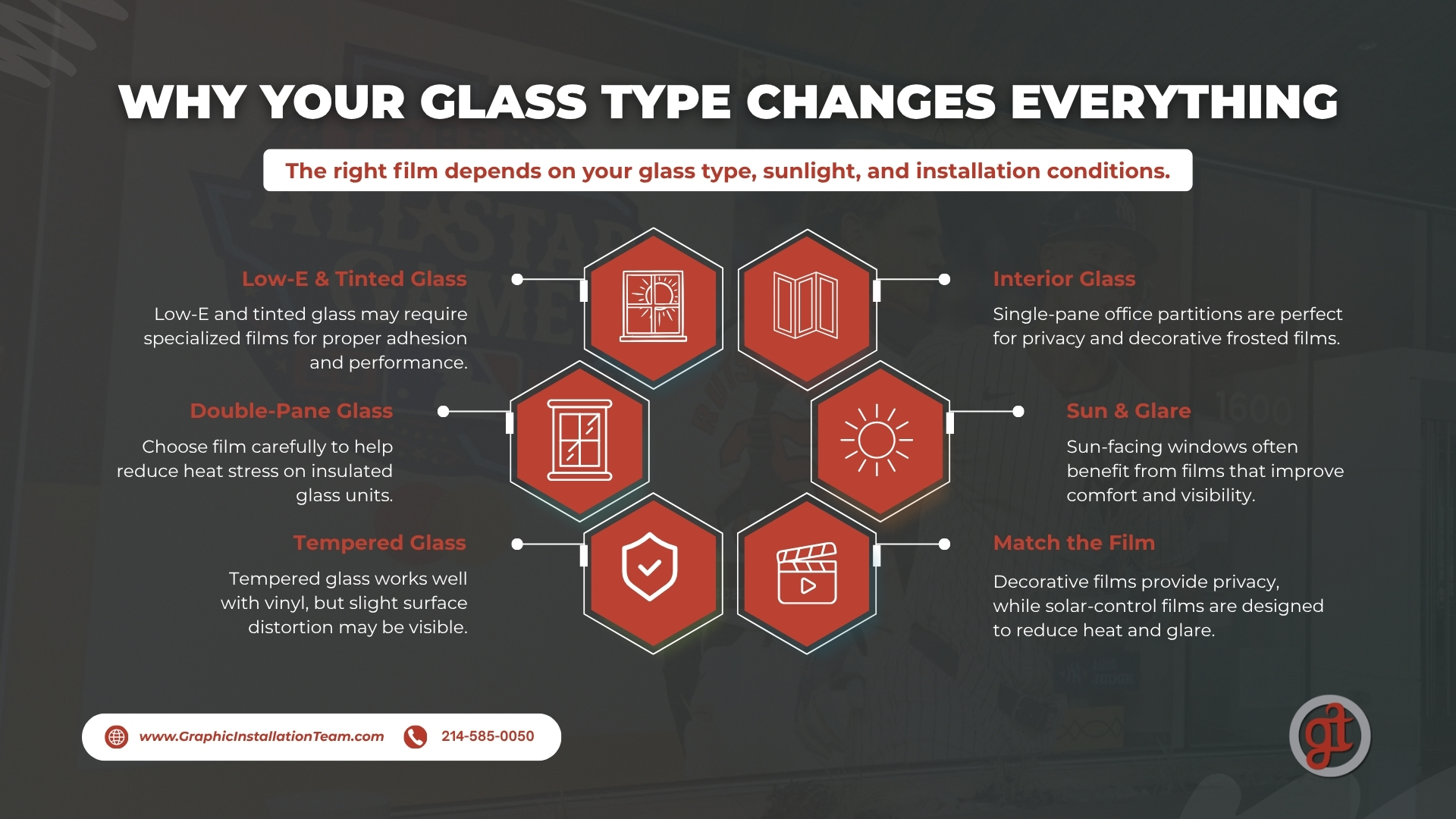
This is the part sign-shop pages skip, and it is the single biggest driver of whether a Dallas office job goes smoothly. Vinyl and film do not bond to “glass” in general. They bond to a specific glass, in a specific condition, at a specific temperature.
Here is what we check on every survey and why it matters:
Low-E and tinted glass
A lot of newer Dallas office towers and remodeled suites run soft-coat Low-E or factory-tinted glass to cut cooling load. Two things follow. First, if the Low-E coating sits on the interior surface, some films and adhesives do not bond the way they would to plain glass, so material choice matters. Second, applying dark or heat-absorbing graphics to a tinted insulated unit can raise the glass temperature and add thermal stress. On south and west exposures, where Dallas afternoon sun is brutal, that stress is real. We flag it rather than gamble your glass.
Insulated (double-pane) units
Most commercial exterior glass in Dallas is an insulated glass unit, two panes with a sealed air gap. A properly built commercial IGU has a realistic service life in the range of 15 to 25 years before edge-seal failure becomes likely (industry figures, not a guarantee on your specific glass). Full-coverage dark film on an IGU can accelerate that by driving up heat at the edge seal, so for exterior sun-facing units, we lean toward lighter or perforated options and talk it through before anyone commits.
Tempered and safety glass
Storefront and door glass is often tempered. Vinyl applies fine to it, but the surface can carry a faint roller-wave distortion, and any imperfection under a large clear or gloss graphic will show. We note it up front so a mirror-smooth expectation meets reality.
Single-pane interior partitions
The easiest case. Interior glass office fronts and partitions are usually single-pane, room-temperature, and ideal for frosted privacy film. These jobs go fast and clean, which is why frosting is our most common Dallas office install.
Glare, Sun, and the West-Facing Problem
Dallas gets long, low, hot afternoon sun. On the west and southwest windows, that light hits the screens and creates glare that no amount of blinds fully solves. This is where the right film earns its keep, and where the wrong expectation causes complaints.
Frosted and diffusing films soften direct glare and are genuinely useful in sun-facing conference rooms where people present on screens. What they do not do is act as a solar-control tint. If your real goal is heat and glare rejection, that is a different product than decorative frost, and pretending one does the other leads to a redo. We tell you which problem your film actually solves, so you order once.
One practitioner notes, specific to Texas summers: adhesive and film behave differently when the glass surface temperature climbs. Exterior glass on a July afternoon in Dallas can run far hotter than the air, and hot glass changes how vinyl lays down and cures. For exterior sun-facing work, we schedule around the heat, often earlier in the day or with the glass shaded, so the material bonds properly instead of fighting a 130-degree surface.
Permits, Landlords, and the One Question That Saves You a Week
Here is the honest local answer, and it surprises people. Interior privacy frosting and lobby wall branding rarely trigger a City of Dallas sign permit because they are not advertising signs readable from the public right-of-way. Street-facing window lettering and promotional graphics can be a different story.
For premise-attached signage, Dallas rules are worth knowing before you design street-facing glass:
| Item | What Dallas expects | Why it matters to your design |
| Window coverage | Signs kept to roughly the bottom third of the window, top two-thirds clear, and a limited share of the window area | A full-coverage storefront concept may need redesign to comply |
| Sign permit | Required for premise-attached signs, a recent fee figure is around $296 (verify current amount with the city) | Budget and timeline, not just material cost |
| Contractor registration | The city expects a registered sign contractor and an approved Certificate of Occupancy on file | Affects who can pull the permit |
| Landlord approval | Office towers and retail centers usually have their own signage standards | Often the real gatekeeper, stricter than the city |
Treat these as directional; verify current specifics with the City of Dallas Building Inspection Division and your lease. The single question that saves a week: “Is this graphic advertising, readable from the street?” If yes, we raise the permit and landlord conversation before art is finalized. If it is interior privacy or branding, we usually move straight to scheduling.
For landlords, the practical gate is a certificate of insurance and a work-window agreement, and yes, our crews carry insurance and coordinate access with building staff. In a managed Dallas tower, the COI and after-hours access approval often take longer than the install itself, so we start that paperwork early.
How Long Office Vinyl Lasts and What Drives the Timeline
Buyers ask two fair questions before signing off: how long will this last, and how long will the install take? Honest answer on lifespan: it depends heavily on where the graphic lives. Interior frosted film on a climate-controlled office partition tends to outlast exterior storefront vinyl by years, because it never sees direct Texas sun, rain, or the daily heat swing that ages adhesive. Quality interior films commonly hold up well past five years in an office setting, while sun-blasted exterior graphics on a west-facing storefront age faster and should be treated as a shorter-cycle item you refresh. These are general ranges from field experience, not a warranty on your exact material.
On the timeline, the install itself is rarely the long pole. What stretches a project is everything before the squeegee: getting print-ready art finalized, confirming glass type on a survey, and clearing landlord or city approvals for street-facing signage. Once material is on site and access is arranged, a commercial graphics installation moves quickly. We would rather add a day to the front-end survey than run into a Low-E coating or a permit rule on install morning.
What Install Day Looks Like, Room by Room
Once material is on hand and any approvals are cleared, the commercial graphics installation itself is fast when the prep is right. Here is the honest sequence.
Cleaning comes first, and it is not a quick wipe. Every square inch of glass or wall gets cleaned down to remove dust, silicone residue, and cleaner film, because a single speck under frost or gloss vinyl shows forever. On construction-adjacent sites, we time this after other trades, since drywall dust and window-cleaner overspray are the two most common causes of a lifted edge.
Next comes the dry-fit and position. For frosted privacy panels and lobby logos, exact height and centering matter more than clients expect, so we measure to the mullion and the eye line, hinge the piece, and confirm before committing adhesive.
With placement locked, we apply and work out the air. Wet or dry method, depending on the material and glass, squeegee from center out, and detail every edge. On large lobby walls, we plan seams where they hide in the architecture, not across a logo.
A frosted conference-room set can be a same-morning job. A full lobby branding package with murals and multiple glass fronts is usually a half to full day, sometimes after hours in a live office, so we are not working around a meeting. We give you a realistic window during the survey, not a hopeful one.
Choosing an Installer Versus a Full Sign Shop
This trips up buyers, so we say it plainly. A traditional sign company designs, prints, and installs. We are a certified, install-only crew. That is a feature, not a gap, if you already have art or a printer, or if you are a national brand rolling out a Dallas location to spec.
You bring the finished, print-ready graphics or your chosen print vendor. We bring a 3M-certified application, the survey, the glass-type judgment, and clean execution. If you need design and print handled too, a full sign shop is the right call. If you have the art and want it installed correctly on tricky glass, that is exactly what we do, and it is why designers and print shops hand us the wall and window graphics installation on their jobs.
A quick checklist before you request a survey
Bring four answers, and any quote conversation gets specific fast. Name the room and its purpose, name the glass if you know it, note the sun exposure, and say whether the graphic reads from the street. Those four points tell an installer almost everything about material choice, scheduling, and whether a permit even enters the picture. Walking in with them is the difference between a same-day frosted conference room and a stalled project waiting on a redesign.
Where to go from here
Frost versus lettering, interior branding versus storefront graphics, these are easier calls once someone has stood in your space and looked at the glass. Our crews cover the wider metro, and a survey turns a vague idea into a firm plan with real dates. When you are ready to move from planning to a scheduled install, the team at Graphic Installation Team can walk your office, confirm your glass type, and handle the wall and window graphics installation start to finish.
