 Call Us: 214-585-0050
  Find A Location
  sales@graphicInstallationteam.com
A realistic fleet graphics install budget in Dallas for 2026 is about $300 to $1,200 per vehicle for labor on a full wrap, before print and design. That maps to roughly $3.50 to $4.20 per square foot of applied vinyl, and to install times of 6 to 8 hours on a standard cargo van, up to 2 to 3 days on a 26-foot box truck. Partial wraps and door-and-panel spot graphics cut that labor by 40 to 55 percent. Removing and decommissioning old graphics is a separate $300 to $800 per vehicle. We install print from any source, so if your wrap is already printed, you can budget the application by itself and skip paying a full-service shop’s markup on film you did not buy from them.
What This Budget Guide Actually Breaks Out
Most fleet pricing you find online quotes one blended number per vehicle, usually $1,500 to $5,000, and rolls print, design, film, and labor into it. That is fine if you are buying everything from one shop. It is useless if you already have your artwork printed, or a print vendor lined up, and you only need certified hands to apply it correctly.
We are an installation-only company based in Anna, TX, working in Dallas, Fort Worth, McKinney, and Plano, so we live in the labor line other quotes hide. Below, we pull it out on its own: what the application costs per vehicle by type, how install hours stack up across a real fleet, what removal of the old graphics adds, and how a multi-vehicle rollout is staged so your trucks are not all off the road at once. You will also see why a fleet with print already in hand still needs a certified installer, and why that step is where most of the money you have already spent is either protected or wasted.
Fleet Graphics Install Budget in Dallas: The Labor-Only Bands
Here is what the application labor runs on its own in 2026, before any print or design. Industry cost data this year puts install labor at roughly 36 to 43 percent of a premium wrap’s total, which works out to about $3.50 to $4.20 per square foot of applied vinyl. Translate that to whole vehicles, and you get the bands below. Read them as ranges, because condition, curves, rivets, and how clean the surface is all move the number.
| Vehicle type | Full wrap install hours | Labor-only budget (full wrap) | Partial or spot graphics labor |
| Full-size pickup | 5 to 7 hours | $350 to $650 | $200 to $400 |
| Standard cargo van | 6 to 8 hours | $400 to $750 | $250 to $450 |
| Extended cargo van | 8 to 12 hours | $600 to $950 | $350 to $600 |
| Sprinter (standard) | 8 to 12 hours | $650 to $1,000 | $350 to $550 |
| Sprinter (high-roof extended) | 12 to 16 hours | $900 to $1,400 | $500 to $800 |
| Box truck, 16 ft | 12 to 16 hours | $900 to $1,400 | $500 to $800 |
| Box truck, 24 to 26 ft | 18 to 24 hours | $1,200 to $2,000 | $700 to $1,100 |
| 53 ft trailer | 3 to 5 days | quoted per unit | quoted per unit |
A few honest caveats on that table. The low end assumes a clean, straight-panel vehicle and artwork that is already printed and trimmed. The high end assumes a lot of compound curves, deep recesses, door handles, and rivets that each add tedious application time. A box truck’s flat slab sides look easy, but the corners, rear roll-up door, and cab transition are where the hours go. When you scope a fleet graphics installation across mixed vehicle types, price each body style on its own row rather than averaging, or your budget will be wrong on both ends.
Why a Print-Supplied Fleet Still Needs a Certified Install
This is the part fleet managers underestimate. You can have flawless print in hand and still lose the whole job at the application stage. Vinyl is unforgiving, and a wrap is only as good as the person laying it down.
Certified application is what separates a wrap that lasts its full service life from one that lifts at the edges by month four. A 3M-certified graphic installer knows the film’s specific overlap allowances, the post-heat temperatures that lock the adhesive, and the rivet and recess technique that keeps a graphic from tenting and peeling. Get that wrong, and the print you already paid for fails early, and cheap film or a rushed application is exactly what makes removal a nightmare years later.
There is a real practitioner reason to insist on this in North Texas specifically. We stage and pre-warm film before application because DFW summer surface temps change how the adhesive behaves. Apply cold film to a truck that has been baking in a Plano lot at 140 degrees on the panel, and the adhesive grabs too fast to reposition, so you get bubbles and crooked panels that only show up once the vehicle cools. We let the vehicle and the vinyl equalize in a controlled bay before a single panel goes on. That is not a step a general handyman or a cheap mobile installer builds into the day, and it is why supplied-print jobs still belong with a certified crew.
Because we are print-agnostic and installation-only, you are not tied to buying film from us to get that certified application. If your print vendor already produced the wrap, we apply it. If you want us to coordinate with your printer on bleed, panel splits, and cut lines before production, we do that too, which prevents the most common and expensive surprise: artwork that was printed without accounting for how it wraps around a real vehicle.
Multi-Vehicle Rollout Logistics Nobody Quotes You For
A single van is a scheduling non-event. A 20-truck fleet is a logistics problem, and the logistics decide your real cost more than the per-vehicle rate does. The mistake we see most often is a company that budgets the install labor correctly and then loses far more than they saved by pulling every vehicle off the road in the same week.
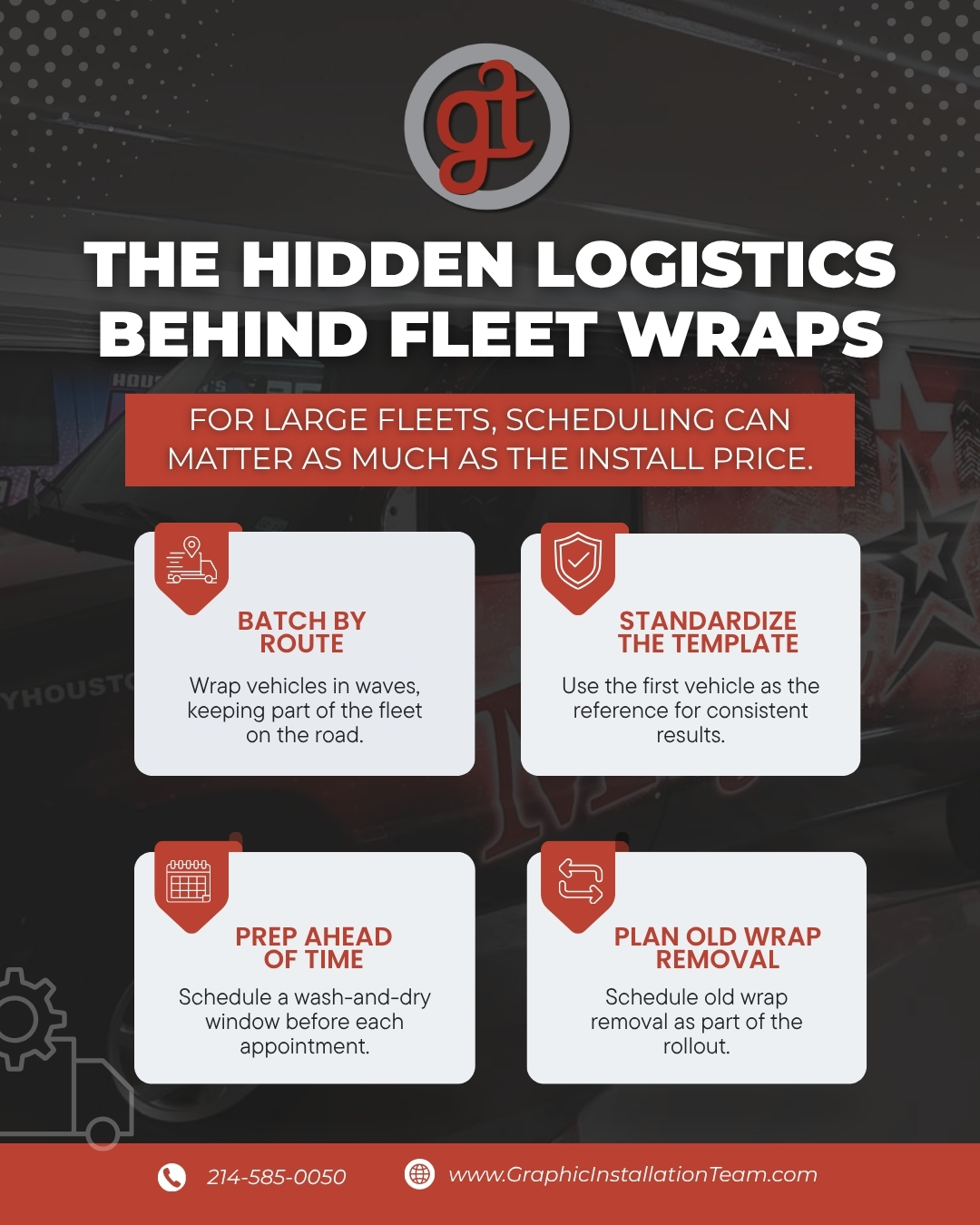
Here is how we stage a Dallas fleet rollout so the branding lands consistently without gutting your operations:
- Batch by route, not by convenience. We wrap in waves so a working portion of your fleet is always on the road while another portion is in the bay.
- Standardize the template once, then repeat. The first vehicle of each body style is the reference build. Every matching unit after it goes faster and looks identical, which is the whole point of a fleet.
- Stage vehicles ahead of their slot. A truck that arrives dirty or wet cannot be wrapped that day, so we set a wash-and-dry window before each unit’s appointment.
- Plan the decommission at the same time. If trucks are coming off an old wrap or a previous brand, removal has to be sequenced into the same rollout, not discovered mid-project.
Consistency across the fleet is where the branding value actually lives, and it is also where amateur installs fall apart. Ten trucks wrapped by ten different sets of hands will not match. Small differences in seam placement and color registration across vehicles read as sloppy to the public, which quietly undercuts the commercial graphics installation you paid for. One crew, one template, one standard is how a fleet looks like a fleet.
What Removal and Decommissioning Adds
Budgets almost always forget the back end. If your vehicles carry old graphics, a previous brand, or a failed wrap, that material has to come off before new print goes on, and that is its own line.
Plan on roughly $300 to $800 per vehicle to remove and decommission old graphics, depending on the film’s age and quality. This is where a past decision to save money bites hardest. Cheap film applied without heat, or a wrap left on years past its service life, bakes onto the panel and fights removal, and that turns a two-hour peel into a full-day scrape with adhesive remover and a heat gun. When a fleet is retired, sold, or rebranded, deidentification is not optional, and the film you chose years ago decides whether that step is quick or painful.
The practical takeaway for your 2026 budget: if any vehicle in the fleet already wears graphics, add a removal line for it now. Discovering it mid-rollout is how a clean project slips its timeline and its number.
Where the WBE and Installer-Only Status Actually Matters to Your Budget
Two of our differentiators are not just marketing; they change what a fleet manager can do with the budget.
We are installation-only and print-agnostic, which means we do not push you toward a specific film supplier or a bundled print package to protect our own margin. You source print where it makes sense for you, and you pay us for the application. For a fleet that already has a preferred print vendor, or in-house design, that decoupling can take real cost out of the total, because you are not paying a full-service shop’s markup on materials you could buy directly.
We are also a certified Woman-Owned Business (WBE). For companies and public agencies in Dallas working toward supplier-diversity goals on their fleet spend, routing the Dallas Graphic installation through a certified WBE vendor can count toward those targets. If your organization tracks diverse-supplier participation, the install portion of a fleet graphics project is a straightforward place to book it, and it costs you nothing extra to do so.
Neither of these changes the labor bands above. What they change is your flexibility on the rest of the budget, and for a multi-vehicle rollout that flexibility is worth real money.
How to Read a Fleet Install Quote So You Compare the Same Thing
Two quotes for the same fleet can differ by thousands because they are not describing the same scope. A clean install-only bid should spell out these lines so you can lay two of them side by side:
- Labor priced per vehicle by body style, not one blended fleet average.
- Whether print and design are included or supplied by you (this alone can double or halve a number).
- Removal and decommission of any existing graphics, listed per vehicle.
- The installer’s certification (3M-certified matters for warranty and film handling).
- The rollout schedule and how many vehicles are off the road at once.
- Any pickup, staging, or wash requirements and who is responsible for them.
If one bid is dramatically lower, it is almost always missing a line above, usually removal or the certified-application step, not offering a genuine bargain. A fair install quote looks a little higher on paper than a mobile installer’s cash rate, and costs far less over the years you run the fleet, because the wrap stays put and comes off clean when you rebrand.
Putting it into practice
The honest version of a fleet graphics install budget in Dallas is a set of ranges, not a single sticker, and the number that matters is the install labor pulled out on its own: roughly $300 to $1,200 per vehicle for a full wrap, less for partials, plus removal where old graphics exist. Get that line itemized by body style, sequence the rollout so your fleet keeps working, and insist on certified application even when your print is already produced. If you want a straight install quote with per-vehicle labor, a rollout schedule, and decommission all spelled out, Graphic Installation Team will scope your fleet, apply print from any source under 3M-certified standards, and hand you a number you can actually plan against, with no pressure to buy film you do not need from us.
