 Call Us: 214-585-0050
  Find A Location
  sales@graphicInstallationteam.com
The corner of a door panel starts to curl about three weeks after a winter install, and by then everyone has forgotten what the weather was doing on the day the graphic went on. That curl is rarely a bad batch of film. It is a bond that never finished forming, on a panel that went into service before it was ready.
TL;DR
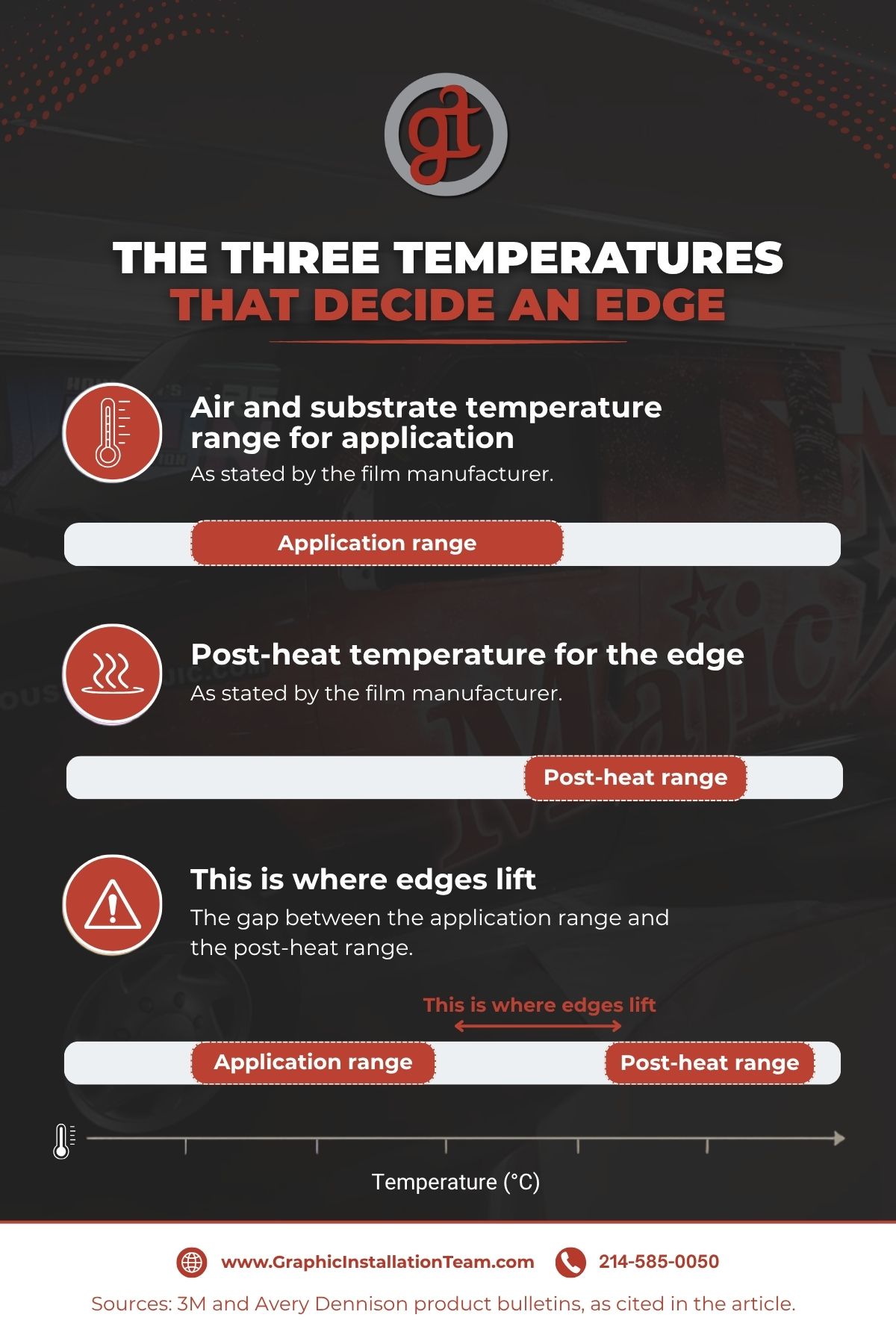
Cold-weather vinyl installation works, but the numbers that govern it are stricter than most people expect, and they aren’t one number. 3M’s own product bulletin for a common fleet film gives three different minimum application temperatures depending on what the film is going over: flat panel, riveted and corrugated, or compound curve and recess. A fleet vehicle has all three on the same truck, so the tightest one governs the day.
Two conditions then decide whether the bond survives. The substrate has to be above the dew point so moisture is not condensing under the film, and the edges, rivets, and seams have to be post-heated during the final squeegee. Avery Dennison is blunt about what skipping the wait costs, noting that below the recommended low application temperature, adequate adhesion can take days, and that moving the vehicle before a functional bond forms is a risk. Cold does not stop the work; it changes the schedule, the sequence, and the handover.
Why Do Wrap Edges Lift After a Cold Install?
Film fails at its edges in the cold for a reason that is mechanical rather than mysterious.
3M’s general application bulletin describes what happens below the recommended minimum plainly: films and sheetings become stiff and brittle, the adhesive cannot bond adequately with the substrate, and air may be trapped, causing bubbling. Every part of that sentence points to an edge. A stiff film does not want to lie down into a rivet head or around a door return. An adhesive that has not properly wetted out is weakest exactly where the film is trying hardest to spring back. Trapped air migrates to the nearest release point, which is the edge.
The middle of a flat panel forgives a cold install. The perimeter, the rivet line, and the seam do not.
That is also why the fix is specific rather than general. 3M’s bulletin does not say “warm the vehicle up”. It says to give special consideration to graphics applied near the minimum application temperature, and to use a heat gun along the rivets, film edges, substrate seams, and overlaps when re-squeegeeing, because graphics applied near the minimum and then put straight into winter service may not develop ultimate adhesion. The full procedure is in 3M’s instruction bulletin on general dry application, dated February 2023.
The Minimum Temperature Is Three Numbers, Not One
This is the part that surprises people who have only ever seen a single figure quoted, and it is the single most useful thing on this page.
3M’s product bulletin for its Controltac graphic film with Comply v3 adhesive, a workhorse for fleet work, sets the application temperature range by what the film has to do:
| What the film is going over | Application range | In Fahrenheit |
| Flat surfaces | 4 to 38 degrees C | about 39 to 100 F |
| Simple curves, corrugations and rivets | 10 to 38 degrees C | about 50 to 100 F |
| Compound curves, recesses and channels | 16 to 32 degrees C | about 61 to 90 F |
3M separately recommends 18 to 22 degrees C, roughly 64 to 72 F, for optimum ease of application. Those figures come from 3M’s product bulletin for IJ180C, and every film carries its own numbers in its own bulletin, which is why we read the bulletin for the film on the job rather than working from a remembered figure.
Now put a box truck in front of that table. The side panel is flat. The rivet line along the lower rail is corrugation and rivets. The door return, the mirror bracket surround, and the recessed step are compound curves and recesses. One vehicle, three ranges, and the tightest range on the vehicle is the one that governs the whole install.
A morning reading 45 F is fine for the flat panels and out of range for everything the film actually has to conform to. A crew working from the flat-panel number will get the sides on beautifully and lose the returns by February.
What this means for a mixed fleet
A fleet is rarely one body style. Cargo vans, box trucks and pickups present different proportions of flat to curved surface, which means they have different effective minimums on the same cold morning.
A box truck side is mostly flat with few recesses, so it has the widest working window. Van bodies with deep returns and door channels are governed by the compound curve number, the tightest of the three. Anything heavily corrugated, such as a roll-up door, sits in the middle range and works slowly.
Sequencing a cold-weather day by body style rather than by whichever vehicle is parked closest is not fussiness. It is how the day fits inside the film’s limits.
The Dew Point Rule Nobody Quotes
Temperature gets all the attention in cold-weather work, and moisture quietly does more damage.
3M’s bulletin states the requirement in one line: the temperature of the substrate must be above the dew point to prevent moisture from condensing on the surface. It adds that in very humid conditions it may be difficult to keep the substrate dry at all.
A cold vehicle brought into a warmer shop is the classic version of this. The panel is below the dew point of the air around it, and a film of condensation forms on the surface faster than a crew can wipe it, sometimes while the wipe is still evaporating. The panel looks clean and dry. The film goes on. The adhesive has bonded to water.
The practical rule is that the surface has to be warmer than the dew point rather than merely dry to the touch, and that a vehicle brought in from the cold needs time to come up to shop temperature before anything is cleaned, not just before anything is applied. Where a panel cannot be warmed, 3M’s bulletin allows the substrate itself to be heated to raise the surface above the specified minimum, using an appropriate portable heater or heat lamps.
Surface preparation does not change in winter so much as it gets harder to confirm. The full sequence we work through is in our guide to preparing a surface for vinyl graphic installation; in the cold, its drying step is the one that needs the extra patience.
When Can a Wrapped Vehicle Go Back on the Road?
Here is the operational fact that changes a winter schedule more than any temperature reading, and it is the one clients are most surprised by.
Avery Dennison’s instructional bulletin for its Easy Apply films puts it directly: ambient temperature is a key environmental factor affecting adhesion, and temperatures below the recommended low application temperature may take significantly longer, even days, to achieve adequate adhesion. The same bulletin warns that until a functional bond is achieved, it is risky to remove premask or to allow the vehicle to be transported, and recommends a minimum of 60°F (16 °C) for optimal application performance. It is published as Avery Dennison’s application instructions for Easy Apply film.
Read that against how a fleet job usually runs. The truck is needed Monday. It gets wrapped Friday afternoon in a cold bay, premask comes off before the crew leaves, and it goes out on a route at highway speed in freezing air over the weekend. Nothing about that sequence is unusual, and every step of it works against the bond.
Avery’s bulletin also gives a way to check rather than guess. Wait several hours after application, then rub a small section firmly with a squeegee fitted with a friction sleeve. Air bubbles larger than roughly half an inch to an inch mean the application method or the temperature was not adequate. If the graphic has to go into service anyway, re-squeegee with greater pressure and overlapping strokes to improve adhesion.
What we change about handover in winter
Post-heating every edge, rivet, seam, and overlap happens during the final squeegee, not as a touch-up afterwards. Premask stays on longer where the schedule allows it. The release time moves so the vehicle sits warm rather than leaving straight into the cold, and the graphic gets re-squeegeed before release rather than left on the assumption that the morning’s work has settled. Then somebody books a follow-up look at the returns and recesses, which is where a cold bond announces itself.
None of that is expensive. All of it is scheduling, and it has to be agreed before the job is booked rather than explained afterwards.
Working Across States in the Same Week
We install nationwide from a base in Anna, Texas, and a winter rollout rarely sits in one climate. The same fleet livery might go on in Dallas on Tuesday and Columbus on Thursday, and those two days are not the same job.
That is a scheduling problem before it is a technical one. The film’s limits do not move, so the plan has to:
- Sequence southern and indoor work into the cold weeks, and hold exposed northern exterior work for a warmer window or a heated bay
- Confirm heated indoor space at each site before committing a date, because a bay is the difference between a workable day and a wasted trip
- Read surface temperature at each location, not the forecast, and not the reading from the last site
- Build the bond time into the delivery date rather than the install date
Interior wall and window work is the natural winter counterweight. It runs in conditioned space at stable temperature all year, which is why we push retail and office graphics into the months when exterior fleet work gets awkward. The differences between the two environments are covered in our comparison of indoor and outdoor graphic installation.
There is also a commercial reason the first quarter suits fleet work, separate from the physics, which we set out in why January to March suits fleet graphics updates. The two arguments sit together: the quarter is right for the business, and the installs inside it need the handling on this page.
Questions Worth Asking Before a Winter Install
Four questions separate a crew that has planned for cold from one that is hoping for a mild morning.
| Ask | What a good answer sounds like |
| What film are you using, and what is its application range? | A named film and its own bulletin numbers, including the tighter range for curves and recesses |
| How will you measure temperature? | Surface readings at several points on each vehicle, not the forecast |
| What is your dew point check? | A stated method, plus how long a cold vehicle acclimates before cleaning |
| When can the vehicle go back into service? | A time, with the reason, and a willingness to move it |
If the fourth answer is “as soon as we are done”, the crew has not read a bulletin recently. Material choice matters too, and we cover how films differ in choosing materials for commercial graphic installations.
Book Cold Weather Fleet Work Around the Bond
Cold weather does not lower the standard; it lengthens the timeline, and the only version of a winter install that fails is the one booked as though it were July. Tell us the delivery date rather than the install date, and we will build the schedule backwards from it. Graphic Installation Team installs vehicle and fleet graphics nationwide, and a site survey is where the heated-space and sequencing questions get answered before a date is promised.
