 Call Us: 214-585-0050
 Find A Location
 sales@graphicInstallationteam.com

A Texas fleet wrap has to carry required markings only when the vehicle under it is one the law reaches. The federal rule covers commercial motor vehicles used in interstate commerce, which by weight start at 10,001 pounds, and asks for the carrier’s name and USDOT number on both sides, readable from 50 feet. Texas adds its own rule for commercial motor vehicles with three or more axles, truck-tractors, road-tractors and tow trucks, and that Texas rule is where the two-inch letter height comes from.
We install wraps. We do not design or print them, and we are not lawyers. What follows describes what the published rules say as we read them on October 12, 2026, and it is legal information, not legal advice: confirm your own carrier status with TxDMV or FMCSA before you approve artwork.
TL;DR
Commercial vehicle marking requirements in Texas come from two places. The federal rule, 49 CFR 390.21T, covers self-propelled commercial motor vehicles in interstate commerce, which the federal definition starts at 10,001 pounds by rating or actual weight, with separate passenger and hazardous cargo tests. It asks for the carrier’s legal name or a single trade name plus the USDOT number on both sides, in sharply contrasting letters readable from 50 feet in daylight. Texas Transportation Code 642.002 separately covers commercial motor vehicles with three or more axles, truck-tractors, road-tractors and tow trucks, on each side of the power unit, and accepts either federal-style markings or the owner or operator name in letters at least two inches high. Neither rule mentions wraps, but a wrap changes the background the marking sits on, so the marking has to be planned into the art before anything is printed.
Which Fleet Vehicles Do the Marking Rules Reach?
Two rulebooks decide it, and they sort vehicles in different ways. The federal rule sorts by where the vehicle works and what it weighs or carries. The Texas rule sorts by axle count and vehicle type. A truck can fall under one, both, or neither, so the first job on any fleet wrap is a list of which units sit where.
The federal test: interstate use plus weight, passengers, or cargo
The federal marking rule applies to every self-propelled commercial motor vehicle subject to the federal motor carrier safety regulations. We read it today in the GovInfo edition of 49 CFR 390.21T, revised as of October 1, 2025. The definitions section of the same part, 390.5T, says a commercial motor vehicle is one used on a highway in interstate commerce to transport passengers or property when it meets any one of four conditions.
| Conditions in 49 CFR 390.5T | The wording that matters |
|---|---|
| Weight | A gross vehicle weight rating or gross combination weight rating, or gross vehicle weight or gross combination weight, of 10,001 pounds or more, whichever is greater |
| Passengers for pay | Designed or used to transport more than 8 passengers, including the driver, for compensation |
| Passengers, no pay | Designed or used to transport more than 15 passengers, including the driver, and not used to transport passengers for compensation |
| Hazardous cargo | Used to transport hazardous material in a quantity that requires placarding |
Two details in that definition catch fleets out. The weight test counts combinations, so a truck and the trailer it pulls are weighed together. And “interstate commerce” is wider than crossing a state line: the definition also takes in a trip between two places in one state when it is part of trade, traffic, or transportation that originates or terminates outside the state.
That second point matters in North Texas. US 75 runs from Dallas through Plano, Allen and McKinney, past our base in Anna, and on into Oklahoma, so a route that follows it far enough is interstate on the plainest reading. A delivery leg from Frisco to Plano may count too if the freight began its trip in another state. Whether it does for your operation is exactly the question to put to FMCSA.
The same part lists exceptions, including government vehicles and the occasional transportation of personal property by individuals outside any commercial enterprise. Read section 390.3T before assuming any of them fits a business fleet.
The Texas test: axles and vehicle type
Texas Transportation Code Chapter 642 makes it an offense to operate four kinds of vehicles on a public street, road, or highway without identifying markings on each side of the power unit:
- a commercial motor vehicle that has three or more axles
- a truck-tractor
- a road-tractor
- a tow truck
Section 642.003 then takes several groups back out. The list includes vehicles registered as commercial farm vehicles, vehicles operated in private carriage that are subject to the federal marking rule, vehicles under the direct control of a public utility that are otherwise visibly marked, and trucks hauling timber products in their natural state from harvest to first processing. An offense under the section is a Class C misdemeanor, and an owner who permits someone else to operate an unmarked vehicle commits one as well.
What neither rule says about a light van
Neither rule uses the words van, pickup, or box truck. A two-axle cargo van is not on the Texas list by axle count. Whether the federal definition reaches it depends on its rating, on anything it tows, and on whether its work is interstate. Those answers live on the vehicle’s rating plate and in your carrier filings, not in the wrap.
So we will not tell a fleet that a given van is exempt, and nobody selling vinyl should.
A third layer sits beside the marking rules. The TxDMV motor carrier registration page says a carrier operating intrastate must register with TxDMV when it runs a commercial motor vehicle or combination with a gross weight, registered weight, or gross weight rating exceeding 26,000 pounds, hauls placarded hazardous materials, operates a vehicle designed for more than 15 passengers including the driver, or moves household goods for compensation at any vehicle weight, among other cases. The same page says a valid USDOT number comes first, registered as intrastate when the operation stays inside Texas. A Texas-only carrier in those groups will hold a USDOT number too.
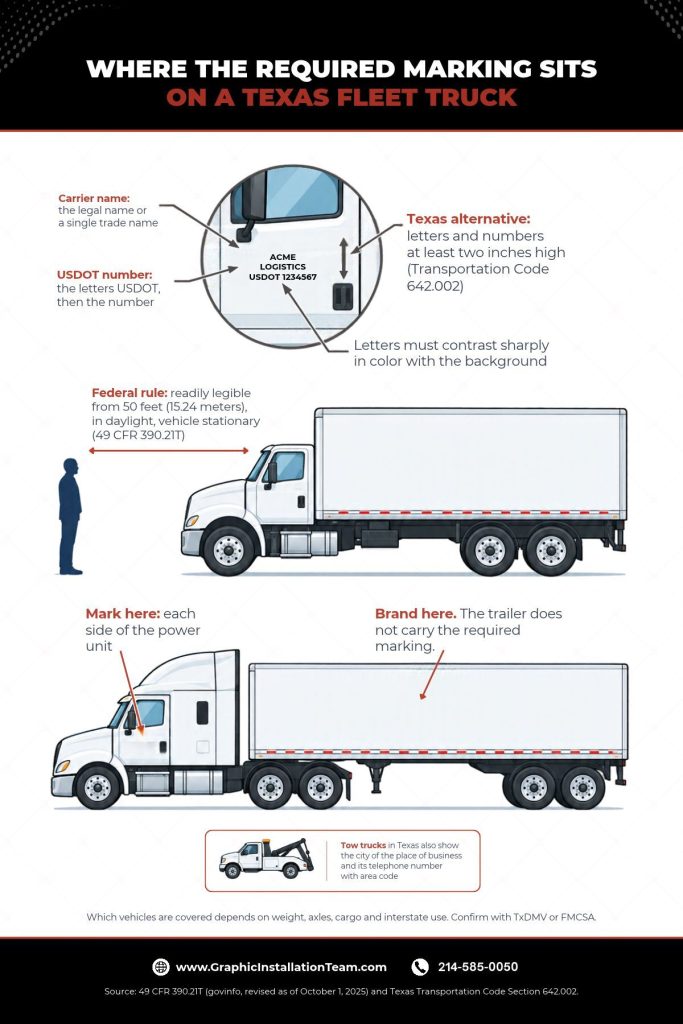
What Has to Appear on the Vehicle
Under the federal rule, two things: the legal name or a single trade name of the motor carrier operating the vehicle, as listed on its Form MCS-150, and the identification number FMCSA issued, preceded by the letters “USDOT.” Other identifying information may be displayed as long as it is not inconsistent with those two items.
Texas gives covered vehicles a choice. The markings can comply with the federal rule, or they can show the name of the owner or operator in clearly legible letters and numbers at least two inches high, together with the motor carrier registration number when the vehicle is required to be registered. The Texas Department of Public Safety, which enforces this on the roadside, summarizes it on its commercial vehicle markings page, dated August 19, 2020, as the USDOT number and the legal name of the carrier for three-axle commercial motor vehicles, truck-tractors and road-tractors.
| Vehicle | Rule | What must show | Where |
|---|---|---|---|
| Commercial motor vehicle in interstate commerce | 49 CFR 390.21T | Legal name or single trade name, plus “USDOT” and the number | Both sides of the self-propelled vehicle |
| Commercial motor vehicle with three or more axles, truck-tractor or road-tractor in Texas | Transportation Code 642.002 | Federal-style markings, or owner or operator name with the motor carrier registration number where registration is required | Each side of the power unit |
| Tow truck in Texas | Transportation Code 642.002(b) | The markings above, plus the city of the place of business and its telephone number with area code | Each side of the power unit |
Tow trucks are the one group with extra wording. If a wrap shop hands you a tow truck layout with a logo and a phone number but no city, the statute has not been read.
How Big Do the Letters Have to Be?
It depends on which rule the vehicle is marked under. The federal rule sets no letter height at all. It requires letters that contrast sharply in color with the background and are readily legible, during daylight hours, from a distance of 50 feet (15.24 meters) while the vehicle is stationary. The two-inch minimum belongs to the Texas alternative in section 642.002, and it applies to letters and numbers alike.
Put plainly, two inches is a Texas floor for the vehicles on the Texas list that are not marked the federal way. It is not a national USDOT lettering size.
The Department of Public Safety page links itself. Beside the two-inch clause in its copy of the statute, DPS has added a note pointing to the federal 50-foot legibility wording. We take that as a hint about how the marking gets judged at the roadside: can an officer read it from across a lot.
The federal test is also one anybody can run. Park the truck in daylight, pace off 50 feet, and read the name and number out loud. If you hesitate over a digit, so will an inspector.
The Name on the Wrap and the Name on the Filing
Here is where wrap projects drift furthest from the rule. A wrap is built around a brand, and the brand on the side of the truck is often not the carrier’s name on file. The federal wording is narrow: the legal name or a single trade name, as listed on the MCS-150. A product line, a slogan or a franchise banner is none of those unless it is the trade name the carrier actually filed.
The rule expects that situation. When the name of any person other than the operating carrier appears on the vehicle, the operating carrier’s own identification has to appear as well, introduced by the words “operated by.”
A franchisee running trucks in the franchisor’s colors is one case. A contractor whose truck carries a customer’s campaign is another.
The Texas alternative uses different words: the name of the owner or operator of the vehicle, and the statute defines an owner as a person with legal title or the right to possess or control it. On a leased unit, those may be two different companies, which is one more reason the wording on the door is a decision for the fleet’s compliance person and not for the designer. Our part is to install what the proof says, in the place the proof shows.
Where a Wrap Design Loses the Marking
A wrap is advertising first. That is the whole case we make in our piece on how a vehicle graphic install builds local visibility. The marking is the one part of the side panel that is not advertising, and a layout built purely to sell tends to squeeze it. These are the failures we would look for on a proof.
| What the design does | Rule wording it runs into | Layout that avoids it |
|---|---|---|
| Sets the number over a photo, gradient or pattern | Letters must “contrast sharply in color with the background” | A solid field behind the name and number |
| Runs characters across a door gap, handle recess or body molding | “Readily legible” from 50 feet | Keep every character on one flat panel |
| Puts the marking on the trailer because the trailer is the billboard | Texas: “each side of the power unit” | Mark the tractor or truck doors, brand the trailer |
| Uses a different layout on each side and drops the marking from one | Federal: “both sides”; Texas: “each side” | Place it on the driver and passenger sides before anything else |
| Shrinks the lettering to keep the door clean | Texas alternative: at least two inches | Fix the height first, design around it |
Contrast is the one that changes most when a fleet moves from paint to a wrap. Black door lettering on a white work truck had contrast for free. Once the door is printed, the background is whatever the artwork puts there, and a number that sits half on dark and half on light is hard to read at ten feet, never mind 50.
There is also a production choice to make: print the marking into the wrap panel, or apply it as cut vinyl on top. Printed in, any change to the name or number means reprinting and reinstalling that panel. Applied on top, the marking can be replaced by itself. The trade-off is that small cut characters have a lot of edge for their size, and edges are where a cold install shows its mistakes first, which we cover in why wrap edges lift after a winter install.
Can the Marking Be a Magnet or a Removable Decal?
Under the federal rule, yes. Paragraph (d) says the marking may be painted on the vehicle or may consist of a removable device, as long as the device meets the same identification and legibility requirements and is kept legible. Nothing in that paragraph asks for a permanent marking.
Removable does not mean optional while the truck is working. The rule still asks for the marking on both sides of the vehicle, and a magnet riding in the cab is legible to nobody. Magnets have a material problem too: they do not hold on aluminum body panels. Our comparison of how wraps, decals and magnetic signs suit a fleet goes through that side of the choice.
Short rentals get their own paragraph. A carrier operating a rented vehicle under an agreement of 30 calendar days or less can meet the rule in one of two ways. The first is to mark the truck as its own. The second is to rely on the lessor’s name and USDOT number displayed on the vehicle, with a rental agreement carried on board that contains the details the rule lists. That matters for fleets that add rented box trucks in the fourth quarter and wonder whether each one needs lettering.
Install Day: Checking the Marking Before the Truck Leaves
By install day, the legal questions should already be closed. What is left is checking that the vinyl on the truck matches the decisions on paper. This is the sequence we suggest to fleet managers across Dallas, Fort Worth, Plano, and McKinney, regardless of which shop printed the job.
- Have the list of units that need markings, and under which rule, from whoever owns compliance at the carrier.
- Read the name and number on the proof against the carrier’s own filing, character by character.
- Confirm the marking is on the power unit, not only on a trailer.
- Look at both sides. Then look again at the passenger side, which is the one that gets skipped.
- Where the Texas alternative is being used, put a ruler on the letters and numbers: two inches or more.
- Park the vehicle outside in daylight, walk back 50 feet, and read it.
- Photograph both sides for the vehicle file.
The duty does not end when the truck rolls out. The federal rule says the marking must be kept and maintained so that it stays legible; a door replaced after a collision, a digit lifted by a pressure washer, or a wrap panel swapped during a rebrand each puts the vehicle back at step one.
Timing helps here. Fleets that refresh graphics early in the year can fold the marking check into that work, and we set out the January to March case for fleet updates in an earlier post. Markings also belong on their own line in the install quote from the start, the way our guide to budgeting a fleet graphics install in Dallas prices each body style on its own row.
Once the covered units and the wording are settled, the rest is ordinary install planning, and our fleet graphics installation crews work from the print your vendor supplies.
Settle the Marking Before You Approve the Art
Before a fleet wrap goes to print, get three answers in writing. Which units are commercial motor vehicles under the federal definition, and which are on the Texas list by axle count or type. What exact name and number each one must show. And whether the marking will be printed into the wrap or applied on top of it.
Take the first two to TxDMV or FMCSA if there is any doubt. Their answer is the one that counts at the roadside, and it costs nothing to ask before the vinyl is cut.
Then send us the approved proof and the unit list. Graphic Installation Team is a 3M-certified, installer-only crew based in Anna, and we install fleet graphics in Dallas, Plano, Frisco, Allen, McKinney, and Fort Worth from the print you supply.
