 Call Us: 214-585-0050
  Find A Location
  sales@graphicInstallationteam.com
A 3M certification buys you a crew that works to two published 3M documents rather than to habit. One is the warranty condition that says your film, ink, and overlaminate have to be matched 3M components. The other is the instruction bulletin for your application, which sets the surface prep, the temperature window, and the post-heat your graphic needs to hold.
The badge is the receipt. The documents are the product.
TL;DR
A 3M certified installer is a company approved through the United Application Standards Group to install 3M graphic films to 3M’s own written procedures, and that approval is what keeps the 3M MCS warranty alive on a finished graphic. 3M states that all warranty coverage depends on using its graphics products as described in the applicable product and instruction bulletins. Those bulletins are specific: clean with detergent, then a solvent cleaner, then an isopropyl alcohol wipe; apply with air and vehicle surface between 60 and 90 degrees Fahrenheit, and post-heat recessed film to 200 to 225 degrees Fahrenheit, measured with an infrared thermometer. Certification means somebody is accountable for all of that.
The Two Documents Behind the Badge
Most explanations of 3M certification stop at the credential. A company passed a test, an auditor visited, a logo appeared on the website. All true, and none of it tells you what changes on your truck.
What changes is that the install becomes governed by paperwork you can read yourself. The first document is 3M’s warranty position. In the 3M Graphics Warranties brochure, 3M writes that “All warranty coverage is contingent upon using the 3M Graphics products as described in the applicable 3M Graphics Product and Instruction Bulletins.”
That single sentence is the whole reason certification carries commercial weight. The coverage is not attached to the roll of film. It is attached to the film being handled a particular way.
The second document is the instruction bulletin for your application. For commercial vehicles, that is 3M’s Application: Vehicles instruction bulletin, published in the same 3M document library, currently at Revision B, May 2026. It runs to nineteen pages, and it is not vague. It names cleaners, tools, temperatures, and the order in which film goes into a recess.
Read those two together, and the picture is simple. The warranty is a promise conditioned on a procedure, and the certification is how a buyer checks that the procedure has an owner.
What Does “Matched Component System” Actually Mean?
MCS stands for Matched Component System, and it means 3M warrants the finished graphic as a set rather than warranting the film alone. The set is the base film, the ink printed on it, and the overlaminate on top. Swap any one of those for a non-3M product, and the graphic is no longer an MCS graphic, whatever the film underneath started as.
That matters because the failures people actually call about are rarely the film tearing. They are the print going chalky on the sun side of a van, or a laminate edge lifting on a door seam after eighteen months. A film-only warranty has nothing to say about either. The matched set is written to cover image cracking, peeling, crazing, and blistering, excessive image fading, excessive dimensional change, and adhesion failure on recommended substrates.
Here is the part buyers miss. Two of the three components are chosen by the printer, not by you and not by the installer.
If your print vendor runs a cheaper third-party laminate to save a few dollars a square foot, the graphic arrives at the install bay already outside the system, and no amount of careful application puts it back inside. That decision moves the material line on the quote, which is where what a fleet rebrand costs in 2026 starts to diverge between two bids that look identical.
Ask the print vendor for the film number, the ink, and the laminate number before anything goes on a press.
The Instruction Bulletin Is the Real Job Description
Open the vehicle’s bulletin, and the certification stops being abstract. A handful of the requirements, straight out of Revision B:
| Step | What 3M specifies |
| Wash | 1 ounce of liquid dish detergent per gallon of lukewarm water, then rinse. No soaps containing waxes, oils, or lotions |
| Dry | Clean lint-free paper towels; surface completely dry before anything starts |
| Solvent wipe | A listed solvent cleaner, wiped 12 inches past the graphic area, dried off before it evaporates |
| Second wipe | 3M recommends repeating with 70 percent isopropyl alcohol and 30 percent water |
| Apply | Air and vehicle surface both between 60 and 90 degrees Fahrenheit |
| Conform | Film temperature 130 to 140 degrees Fahrenheit for IJ180Cv3, and never above 212 degrees Fahrenheit where UV-cured inks are involved |
| Post-heat | Recessed film reheated to 200 to 225 degrees Fahrenheit, measured with an infrared thermometer, then re-rolled |
None of that is exotic. It is also nothing like what happens when a wrap gets applied in a parking lot by whoever was free that day. The isopropyl step alone gets skipped constantly, and the bulletin is blunt about why it exists: car wax kills adhesion, and a solvent wipe is the only thing that takes wax residue off.
The post-heat number is the one we would put on a wall if we could. Film pulled into a recess or a channel is under stress, and the vinyl remembers it. Heating the applied film back to 200 to 225 degrees and re-rolling it releases that stress and closes the air channels.
Skip it, and the graphic looks perfect on collection day and starts creeping out of the recess a season later, which is most of what sits behind how long a wrap should last in the field rather than on paper. The bulletin also says to measure that heat with an infrared thermometer rather than guess, which tells you something about how narrow the window is.
Tooling is specified too, which surprises people who assume a wrap is a squeegee and a hair dryer. The bulletin lists a rivet brush, an air release tool for puncturing bubbles cleanly rather than slicing them, a low-friction sleeve or loop material on the squeegee edge so the applicator does not scratch the panel, and a heat gun capable of reaching at least 500 degrees Fahrenheit. It also names 3M Tape Primer 94 as a recommended, not required, aid where film will be stretched.
A crew that carries all of that has made a purchase decision about how it works. A crew that does not is improvising, and improvisation is exactly what the warranty language excludes.
The record nobody asks to see
3M recommends a signed pre-installation inspection record for every vehicle, filled out before any film goes on, identifying problem areas such as unsound paint. The forms are printed in the back of the bulletin. On a fleet, that record is the only thing standing between “the wrap failed” and “panel four had aftermarket paint and here is the signed sheet from March saying so.” Ask any installer whether they complete one per unit, and watch how fast the answer comes.
Why 96 Degree Afternoons Change the Schedule Here
August in North Texas is the season that exposes the temperature rule. The 1991 to 2020 NOAA U.S. Climate Normals put the August normal high at 95.8 degrees Fahrenheit at DFW Airport and 97.1 degrees at Dallas Love Field. 3M’s bulletin says the vehicle surface must be below 90 degrees before the install starts, and if it is warmer, move the vehicle indoors or into the shade and let it cool.
A white box truck parked in the sun off Stemmons at two in the afternoon is nowhere near 90 degrees on the panel. It is well past it. Above the window, the adhesive turns aggressive, Controltac films lose the repositioning that makes clean work possible, and the film grabs the panel before the squeegee gets there and traps air. You get bubbles that were never the installer’s hands.
So the honest answer in a Dallas August is that the schedule bends around the thermometer. Vehicles come inside the night before, or the crew starts at first light in McKinney and Plano before the metal loads up, or the job waits for a bay. Working out which of those applies to your vehicles is one of the things a site survey before the install settles before a date is promised.
When somebody quotes a same-day outdoor wrap on a 100-degree afternoon in Fort Worth, they are quoting a job that cannot be done inside the building. That is not caution. It is the specification.
Winter has the mirror problem. Below the 60-degree floor, the film cools too fast to stretch, the initial bond can be too weak, and condensation forms if the panel drops below the dew point. North Texas gets both ends of that in the same calendar year, which is exactly why a crew here needs a bay rather than a driveway.
What Does the Certification Itself Require?
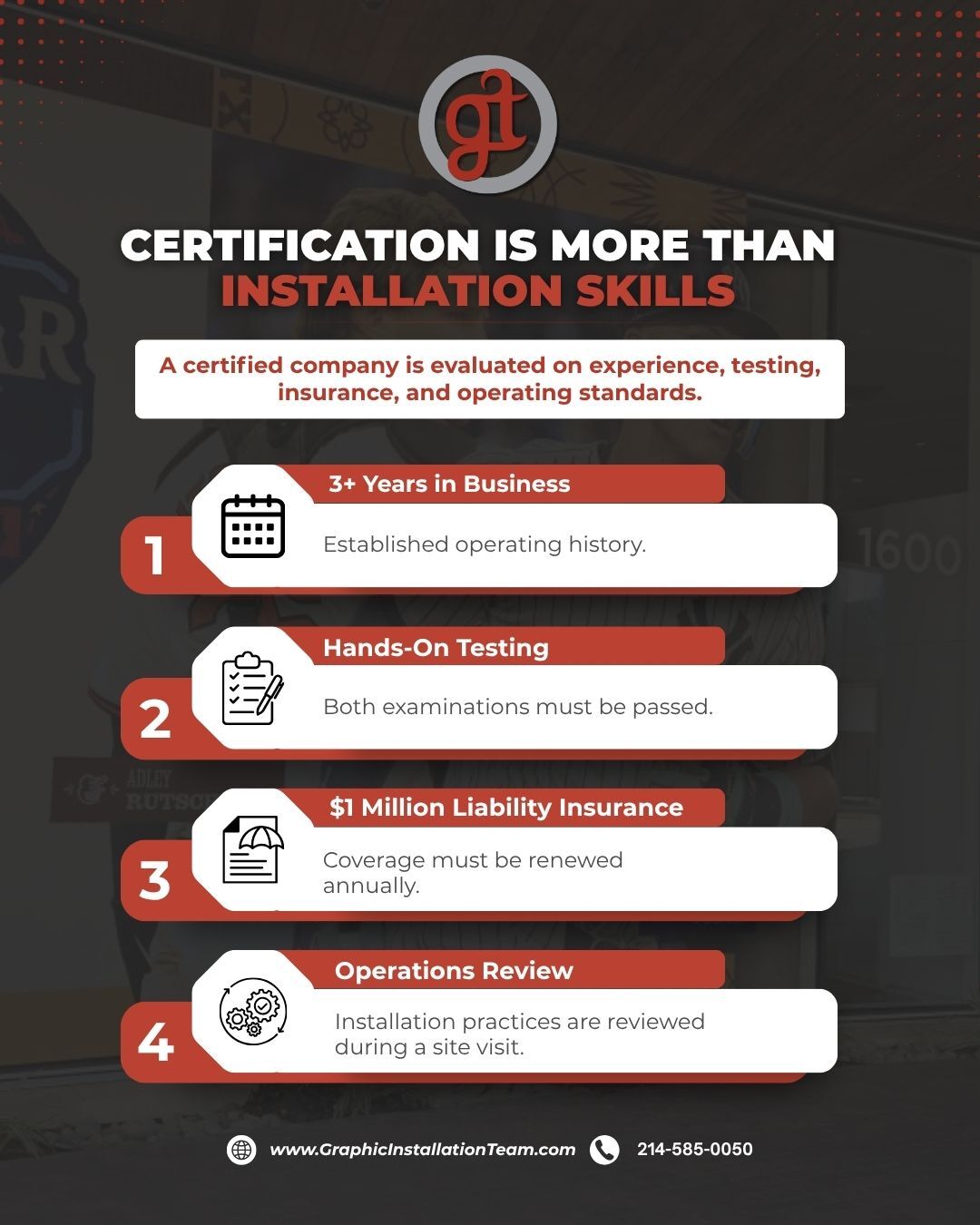
The 3M Certified Graphics Installation Company program is administered for 3M by the United Application Standards Group, and only UASG members may describe themselves that way. Per UASG, the requirements include a minimum of three years in business, passing both a hands-on and a written test at 3M’s headquarters in St. Paul, and a $1 million minimum liability insurance requirement with proof renewed every year. UASG states it has personally visited every member’s business to review operations and installation practices.
Notice what kind of requirements those are. Insurance renewals, years trading, a site visit, a code of conduct. They are business requirements as much as installation ones, because the thing being certified is a company that can repeat a standard across a crew, not a single gifted applicator.
There is a second, separate credential worth knowing. A 3M Preferred Graphics Installer is an individual who has passed advanced testing in a specialty such as fleet or windows. Both are real. They answer different questions, and “we are 3M certified” said quickly can mean either one.
We set certified crews against local wrap shops in more detail elsewhere, including what the audit and the insurance floor actually change on a job site.
What a Certification Does Not Buy You
We would rather say this plainly than let it be a surprise later.
It does not make a bad print good. Certification governs application. If the file was low resolution or the panels were tiled wrong, a correct install produces a correctly installed bad graphic.
It does not cover paint that was already failing. The pre-installation record exists precisely because vinyl pulls on whatever it is stuck to, and repainted panels of unknown history are the usual culprit when film lifts and takes colour with it.
It does not extend the warranty period on its own. Duration comes from 3M’s warranty matrices for the specific film and laminate combination and the exposure, and horizontal surfaces carry shorter terms than vertical ones for good physical reasons.
And it does not stop the damage. A shopping trolley across a door, a tree branch down a trailer side, a pressure washer held four inches from a seam. None of that is a material defect, and none of it is on 3M.
Questions That Separate a Real Answer From a Logo
Four questions, and the useful part is how quickly they get answered.
Which instruction bulletin covers my job, and what revision is it on? A crew that works on the documents will name it. The vehicles bulletin is at Revision B, May 2026, and there are separate bulletins for substrate selection, application tapes, watercraft, and vehicle color change.
What film, ink, and laminate is my printer running? If any of the three is not a matched 3M component, say so before print, not after.
Where will my vehicles be during the install, and what will the panel temperature be? In July and August around Dallas, the correct answer involves shade or a bay.
Do you complete a pre-installation inspection record per unit, and can I have copies? On a fleet, those sheets are your file if a claim ever happens.
Anyone can print a logo. Very few can answer question one without pausing, which is why we lead with it when clients compare us against the certified 3m vinyl installers Dallas search throws at them.
Ask to See the Bulletin Before the Wrap Goes On
If you are scoping a wrap or a fleet rebrand right now, do three things in this order.
- Confirm with your print vendor that the film, ink, and overlaminate are matched 3M components, in writing, before the job goes to press.
- Ask your installer which bulletin and revision they will work to, and where the vehicles will sit while they do it.
- Keep the paperwork: the component list, the pre-installation records, and the install dates.
That folder is what turns a warranty from a sentence in a brochure into something you can actually claim on.
We install to those bulletins on commercial vehicles, storefronts, and building graphics across Dallas, McKinney, Plano, and Fort Worth, and we are happy to walk through a specification with you before anything is printed. Send the vehicle list and the material spec to the Graphic Installation Team, and we will tell you what the bulletin requires for your job, including the parts that will slow the schedule down in August.
