 Call Us: 214-585-0050
  Find A Location
  sales@graphicInstallationteam.com
How early planning, professional installation, and nationwide coordination can keep your year-end graphics projects on schedule
The fourth quarter is one of the busiest times of the year for businesses, retailers, brands, and the companies that support them. Holiday promotions launch, seasonal graphics go up, fleet campaigns hit the road, retail environments change, and end-of-year projects suddenly have firm deadlines that cannot move.
For companies managing graphics at one location – or coordinating installations across dozens or even hundreds of locations – successful execution requires much more than simply shipping graphics to an installer.
At Graphic Installation Team (GIT), we work with clients on commercial graphics installation projects ranging from individual wall murals and vehicle graphics to large-scale, multi-location graphics rollouts. One thing we have learned is that the most successful projects usually have something in common:
The planning starts long before installation day.
As Q4 approaches, here are some of the most important factors to consider when planning your holiday and year-end graphics projects.
TL;DR
A successful holiday graphics installation is won in the planning stage, not on installation day. Start 8–12 weeks before launch (earlier for multi-location or fleet programs), verify every site with a survey, and check wall paint and surfaces before anything is printed.
Then plan for what Q4 adds: holiday blackout dates, cold-weather limits on exterior and fleet installs, vehicle downtime, and January removal. Label every graphic by location, keep communication centralized across markets, and require photo documentation at closeout so every location can be confirmed complete.
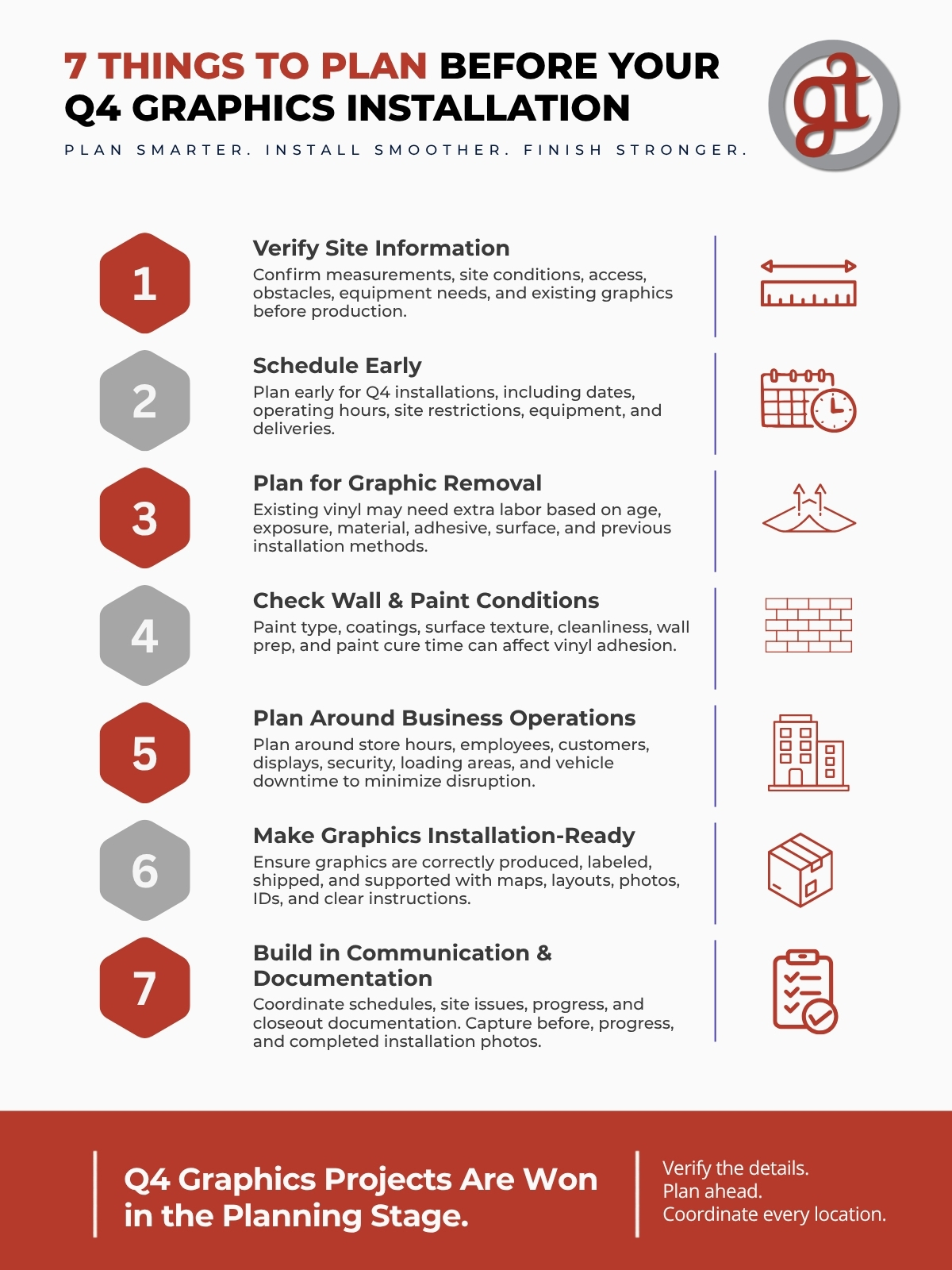
Start With Accurate Site Information
One of the easiest ways for a graphics installation project to go wrong is to begin with incomplete information.
Measurements are important, but a professional graphics site survey can provide much more than dimensions. Depending on the project, a survey can help document surface conditions, installation heights, accessibility, equipment requirements, obstacles, electrical components, existing graphics, wall conditions, and other details that may affect production or installation.
For a retail graphics installation, for example, knowing the dimensions of a wall is only part of the equation. Fixtures, shelving, displays, security equipment, limited working space, customer traffic, or restricted installation hours can completely change how an installation needs to be approached.
The same applies to exterior graphics, window graphics, wall murals, architectural graphics, and specialty installations.
When measurements or specifications are supplied by the client rather than verified in the field, everyone is relying on that information being accurate. A professional site survey can help identify potential problems before graphics are printed, shipped, and sitting at the job site waiting to be installed.
Finding a problem during a survey is inconvenient. Finding it after thousands of dollars of graphics have been produced is expensive.
Give Your Graphics Installer Enough Lead Time
Q4 installation schedules fill quickly.
Retailers are preparing holiday campaigns. Corporate offices are completing year-end projects. Brands are launching promotions. Fleet managers may be trying to complete vehicle graphics before the end of the year.
Meanwhile, many businesses have blackout dates or limited installation windows during the holiday season. That is why early scheduling matters.
If you are coordinating a nationwide graphics installation or multi-location graphics rollout, planning becomes even more important. Each location may have different operating hours, site contacts, installation restrictions, equipment requirements, and delivery schedules.
A national rollout isn’t simply one installation multiplied by 50. It is 50 individual installations that all need to function as one coordinated project.
At Graphic Installation Team, our nationwide installer network allows us to help clients coordinate commercial graphics installations in multiple markets while maintaining communication and consistent project expectations.
Q4 Graphics Rollout Timeline: What Should Happen and When
Every project is different, but working backward from your launch date keeps everyone honest. Here is a simple timeline we recommend for holiday and year-end graphics, especially when more than one location is involved.
| When | What should happen |
|---|---|
| 12+ weeks before launch | Define scope, list every location, identify site contacts, and book site surveys. |
| 10–8 weeks | Complete surveys, verify measurements, check wall paint and surfaces, run adhesion tests on large murals, and evaluate any existing vinyl that must be removed. |
| 8–5 weeks | Approve artwork, move graphics into production, and kit and label every panel by location. |
| 4–2 weeks | Ship graphics, confirm delivery to each site, and lock installation dates around store hours, blackout dates, and fleet schedules. |
| Launch window | Install, document with before, progress, and completed photos, and close out any site issues. |
| January | Remove holiday graphics and, where possible, install Q1 graphics in the same visit. |
Larger multi-location rollouts and fleet programs should start earlier. The more locations involved, the more time you want for surveys and labeling, because that is where most rollout problems begin.
Don’t Forget About Graphic Removal
Removal is one of the most underestimated parts of a graphics project.
Clients often assume removing existing vinyl will be quick because installation was quick. Unfortunately, vinyl doesn’t always cooperate.
The condition of existing graphics can be affected by age, sun exposure, weather, material type, installation surface, adhesive, previous installation methods, and how long the graphics have been in place.
An older vehicle wrap that has spent years exposed to the elements can behave very differently from recently installed temporary promotional vinyl.
Because of these variables, vinyl graphics removal should be evaluated separately from installation whenever possible.
If removal is required before new graphics can be installed, allow adequate time in the project schedule. Discovering that removal requires significantly more labor than expected can delay everything that follows.
Pay Attention to Wall Conditions and Paint
Wall graphics and murals are incredibly effective ways to transform commercial spaces, but the wall underneath the vinyl matters.
Fresh paint, certain low-VOC paints, matte finishes, specialty coatings, textured surfaces, contamination, and improperly prepared walls can all create adhesion challenges.
A wall may look perfectly fine and still not be an ideal surface for vinyl graphics.
For new construction or renovation projects, communicate with your graphics provider before the walls are painted whenever possible. The paint selected for a space can affect the success of the final graphics installation.
Freshly painted walls also need appropriate cure time before graphics are installed. Rushing that timeline can create adhesion problems that may not appear immediately.
For large commercial wall mural installations, testing the surface or performing an adhesion test may be appropriate before moving into full production.
For a step-by-step look at what good prep involves, see our guide to preparing a surface for vinyl graphic installation.
Plan for Cold Weather on Exterior and Fleet Installs
Q4 doesn’t just bring tighter deadlines. In much of the country, it brings colder mornings, and vinyl is sensitive to temperature.
Every vinyl film has a published minimum application temperature, and curves, rivets, and recesses often need warmer conditions than flat surfaces. Below those limits, film becomes stiff and the adhesive may not bond properly. The result is often edges that lift weeks after the installation looked perfect.
For exterior window graphics, storefronts, and fleet vehicles, cold weather can mean scheduling installs for the warmest part of the day, using heated indoor bays, letting vehicles warm up before surface prep, and building extra bond time into the schedule before vehicles go back on the road. Interior wall and window projects in conditioned spaces are far less affected, which is why they can be sequenced into the coldest weeks.
For multi-state rollouts, the same graphic might go up in Texas on Tuesday and Ohio on Thursday, and those are two very different jobs. We cover the details in our guide to wrapping a fleet in cold weather without lifting edges.
Plan Around Business Operations
A successful graphics installation should create an impact without unnecessarily disrupting the client’s business.
That may mean installing overnight, working before a store opens, completing sections in phases, coordinating around employees and customers, or scheduling fleet vehicles so they are not all out of service at the same time.
For fleet graphics installation, downtime can be especially important. A company with 20 vehicles may not be able to take all 20 off the road simultaneously. Instead, vehicles may need to be staged in groups so installation can continue while the fleet remains operational.
Retail environments present different challenges. Installers may need to work around store hours, displays, merchandise, customers, security requirements, loading docks, or shopping-center restrictions.
If a location is being remodeled during the holiday season, barricade graphics can keep the construction area on-brand and customer-friendly while work continues behind it.
These aren’t minor details. They are part of professional graphics installation planning.
Make Sure Graphics Arrive Ready for Installation
The installer may be the last person to touch the graphics, but installation is only one part of the process.
Before an installer arrives, graphics need to be produced correctly, labeled properly, shipped to the correct location, and ready to install.
For multi-location projects, clear labeling becomes especially important.
If Location 12 receives Location 21’s graphics, even the best installer in the country can’t solve that problem with a squeegee.
Production teams, project managers, shipping departments, site contacts, and installers all need accurate information.
Providing installers with elevations, installation maps, photographs, panel layouts, graphic identification numbers, and clear instructions can dramatically improve efficiency in the field.
Working With an Installer-Only Partner
Graphic Installation Team is an installer-only company. We don’t design or print graphics, so we never compete with the print providers, sign companies, and agencies we work with. Your production stays with you, and our 3M-certified installers focus on one job: getting your graphics installed correctly, on schedule, at every location.
Build Communication Into Nationwide Graphics Rollouts
Communication is one of the biggest differences between hiring someone to install vinyl and working with a professional graphics installation company.
Large rollouts involve moving pieces.
Locations change installation dates. Shipments get delayed. Site contacts change. Construction runs behind schedule. Vehicles arrive late. Weather affects exterior installations.
The goal isn’t to pretend those things never happen. The goal is to have a system for handling them when they do.
For nationwide graphics installation projects, centralized communication helps clients keep track of scheduling, installation progress, site issues, and completion documentation across multiple markets.
At Graphic Installation Team, we understand that our clients often have their own clients waiting for updates. Clear communication from the field helps everyone provide accurate information up the chain.
Require Installation Photos and Project Closeout
Installation isn’t complete simply because the vinyl is on the wall, window, vehicle, or building.
Professional project closeout should include documentation.
Depending on the scope, that can include before photos, progress photos, completed installation photos, notes regarding site conditions, and documentation of any issues discovered during installation.
For national graphics programs, this becomes especially valuable. Instead of wondering whether a location was completed correctly, project managers have documentation they can review and provide to their clients.
Photo documentation also creates a record of the condition of the site when the installation was completed.
Schedule Post-Holiday Removal Before the Graphics Go Up
Holiday graphics are temporary by design, but removal is often planned as an afterthought, usually in early January, when everyone wants stores and vehicles reset at the same time.
The simplest fix is to book removal dates when you book the installation. A few other habits help:
- Ask your print provider for films designed for clean, short-term removal from the specific surface they’re going on.
- Don’t leave seasonal graphics up far past their intended life. Age, sun, and weather can make vinyl harder to remove and slow down the next installation.
- If Q1 or spring graphics are replacing holiday graphics, combine removal and the new installation into one coordinated visit to cut trips and downtime.
Q4 Graphics Projects Are Won in the Planning Stage
Holiday and year-end deadlines aren’t very forgiving.
A campaign scheduled to launch December 1 doesn’t have much value if the graphics are installed December 20.
The earlier you begin planning your holiday graphics installation, the more options you have when challenges arise.
Your Q4 Graphics Rollout Checklist
- Verify measurements.
- Understand the installation surfaces.
- Schedule site surveys when necessary.
- Allow adequate production and shipping time.
- Plan for removals.
- Consider business hours and vehicle downtime.
- Communicate installation requirements.
- Check film temperature limits for exterior and fleet work.
- Label every graphic by location before it ships.
- Book post-holiday removal dates now.
And, most importantly, bring your installation partner into the conversation early.
Need Help Planning Your Next Graphics Installation?
Graphic Installation Team (GIT) provides professional commercial graphics installation for businesses, brands, print providers, sign companies, agencies, and organizations needing reliable installation support.
Our capabilities include vehicle and fleet graphics installation, wall murals, retail graphics, window graphics, architectural graphics, vinyl removal, site surveys, and nationwide multi-location graphics rollouts.
We’re a 3M-certified, WBE-certified (women-owned), installer-only company based in Anna, Texas, with 500+ projects completed for brands across the country.
Whether your project involves one location or a coordinated installation program across multiple cities, GIT can help evaluate the scope, identify potential installation challenges, coordinate scheduling, and get your graphics where they belong.
Planning a Q4 or holiday graphics project? Contact Graphic Installation Team early so we can help you build an installation plan before the year-end rush begins.
Call 214-585-0050 or request a quote online.
