 Call Us: 214-585-0050
 Find A Location
 sales@graphicInstallationteam.com

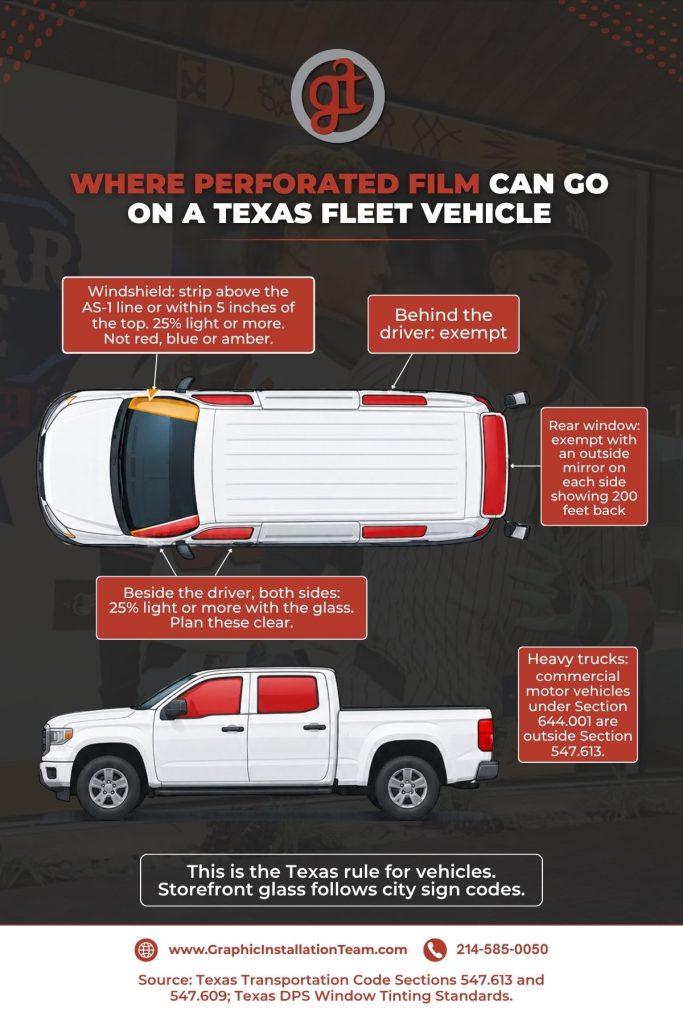
On a Texas fleet vehicle, perforated window film can cover the side windows behind the driver with no light limit at all, and the rear window too, as long as the vehicle has an outside mirror on each side that shows the driver at least 200 feet behind. The windows to the left and right of the driver are a different story. Texas only exempts film there when the glass and film together still let through 25 percent of the light or more, and a printed graphic is built to block the view from outside. Plan the front side glass clear, and the logo has plenty of room everywhere else.
TL;DR
Texas Transportation Code Section 547.613 makes it an offense to drive with material on a windshield or a side or rear window that blocks the driver’s clear view, then lists the exceptions. A side window to the rear of the driver is exempt outright. A rear window is exempt when the vehicle carries an outside mirror on each side reflecting a view at least 200 feet back. The windows beside the driver are exempt only for a sunscreening device that, combined with the glass, passes 25 percent of the light or more and reflects 25 percent or less. The windshield allows a strip above the AS-1 line or within five inches of the top, and heavy commercial trucks are outside the section entirely. For a van, pickup or SUV fleet in Dallas, Plano or McKinney, that means rear doors and rear glass carry the graphic and the driver and passenger windows stay clear.
Which Windows Can Perforated Film Cover on a Texas Fleet Vehicle?
Behind the driver, almost all of them. The rear side windows (the second row on a crew cab, the slider on a cargo van, the quarter glass on an SUV) are exempt from the window restriction with no light figure attached. The rear window joins them once the vehicle has two outside mirrors that show the road 200 feet back. The two windows beside the driver, and the windshield below a narrow top strip, are where the limits sit.
All of this comes from one section of state law. Texas Transportation Code Section 547.613 opens with the offense and then spends most of its length on exceptions, numbered (1) through (16). Only a handful matter to a fleet manager specifying a wrap.
| Window on the vehicle | What Section 547.613 allows | Where it sits in the statute |
|---|---|---|
| Windshield | A sunscreening device above the AS-1 line or within five inches of the top, whichever is closer to the top; 25 percent light transmission or more and 25 percent reflectance or less, combined with the glass; not red, blue or amber | (b)(1) |
| Driver’s window and the front passenger window | A sunscreening device that, combined with the glass, has light transmission of 25 percent or more and luminous reflectance of 25 percent or less | (b)(2) |
| Side windows behind the driver | Exempt, no light figure | (b)(2-a), and (b)(10) for multipurpose vehicles |
| Rear window | Exempt if an outside mirror on each side reflects a view of the highway at least 200 feet to the rear | (b)(3) |
Read the second row twice. “To the left or right of the vehicle operator” means the passenger’s front window too, not only the driver’s door. For a crew cab pickup, the curb side front window is the one that catches people out, because it looks like spare real estate on the proof and the statute treats it exactly like the driver’s glass.
Why the Front Side Glass Stays Clear
The front side exemption is written for one kind of product. It covers a window that “has a sunscreening device,” and the Code’s definitions chapter calls that a film, material or device meeting the Department of Public Safety’s standards for reducing the effects of the sun. The test is a measurement: light transmission of 25 percent or more and luminous reflectance of 25 percent or less, read through the film and the glass together.
A perforated graphic is a different animal. Its job is to print a solid image on the outside face while the driver looks out through the holes, so the product is designed around the outside view, not around a transmission reading. Whether a given printed film would measure above 25 percent on a meter depends on the film, the print and the glass, and the statute offers no shortcut for “you can still see out.” Our view is simple. A graphic that the exemption was not written for is a poor thing to put beside a driver’s head, and a stop on the North Central Expressway is a bad place to find out how an officer reads it.
The federal side points the same way. The federal glazing standard, FMVSS No. 205 in 49 CFR 571.205, states its purpose as reducing injuries from glazing impacts and ensuring “a necessary degree of transparency in motor vehicle windows for driver visibility.” That standard governs how the glass itself is made and marked, not the vinyl added later, but it names the priority the Texas section protects.
There is also the plain question of who carries the risk. Subsection (a)(1) makes it an offense to operate a vehicle with material that obstructs or reduces the operator’s clear view. The driver and the fleet that owns the van, not only whoever laid the film, are the ones standing beside it on the shoulder.
The Rear Window Depends on Two Mirrors
For a fleet in Collin or Dallas County, the rear glass usually comes down to one walk around the lot. The words of the condition are worth checking on every unit: an outside mirror on each side “that reflects to the vehicle operator a view of the highway for a distance of at least 200 feet from the rear.”
The Department of Public Safety reads it the same way in its published tint standards: with those mirrors, there are no restrictions on sunscreening devices applied to the rear window, and without them the rear glass falls back to the 25 percent transmission and 25 percent reflectance test.
Three fleet situations come up often enough to name:
- Cargo vans with rear door glass: The two rear door windows are the rear window for this purpose. With both outside mirrors in place, they can carry the graphic.
- Pickups with a sliding rear window: Same rule. The slider is a rear window, so the mirrors decide it.
- A mirror missing or broken on one side: The exemption is written in terms of a mirror on each side. A van with a cracked or missing passenger mirror is, in the words of the statute, a van whose rear graphic no longer has its exemption until the mirror is fixed.
Put that third point on the fleet maintenance checklist rather than the graphics spec. It is the kind of thing that changes after the install, long after anyone has looked at the proof.
Windshield Banners and the Five-Inch Strip
A windshield banner is allowed, inside narrow lines. Subsection (b)(1) permits a sunscreening device on the windshield only if it does not extend down past the AS-1 line or more than five inches from the top, whichever is closer to the top. It has to pass 25 percent of the light with the glass and reflect 25 percent or less, and it cannot be red, blue, or amber.
That last condition trips more banner designs than the depth does. A company whose brand color is a strong red or blue cannot simply run its logo bar across the top of the windshield in brand colors, on the plain words of the statute. DPS adds that clear, untinted UV film may go anywhere on the windshield without a medical exemption, which does nothing for a printed banner but does answer a question fleet managers sometimes ask in the same breath.
Our advice for most North Texas fleets is to skip the windshield entirely. The strip is small, the color rule is strict, and the doors, sides, and rear already carry the name.
Does the Tint Label Rule Reach a Perforated Graphic?
The statute does not say. Subsection (a-1) makes it a misdemeanor, punishable by a fine of up to $1,000, for a person in the business of placing transparent material that alters color or reduces light transmission to skip the label described in Section 547.609, and the Department of Public Safety’s window tinting standards set out where that label goes. Perforated graphics are not named anywhere in either section, so whether an opaque printed film with holes counts as that “transparent material” is a reading, not a rule.
Here is what the label rule itself requires, from Section 547.609 and the DPS standards:
- The label is legible.
- It carries the information DPS requires on light transmission and luminous reflectance.
- For a windshield or side or rear window, it states that the transmission is consistent with Section 547.613(b)(1) or (2).
- It is installed permanently between the film and the glass.
- DPS reads the section as one label per vehicle, placed at the rearmost bottom corner of the driver’s side window, with wording such as “Complies with TTC 547.613 (b).”
Notice what item 3 assumes. The label certifies the windshield or front side figures, which a fleet following this article never needs, because the windows carrying perforated film are the exempt ones. Even so, ask whoever installs your fleet how they handle the label question and get the answer in writing with the quote. A fleet of forty vans is forty possible conversations at the roadside.
Heavy Trucks, Shuttles and Plates From Out of State
Some fleets sit outside Section 547.613 altogether. Exception (b)(16) covers a commercial motor vehicle as Section 644.001 defines it, and that definition points two ways depending on where the truck runs.
| How the vehicle runs | Where the definition comes from | Main thresholds |
|---|---|---|
| Interstate | 49 CFR 390.5, through Section 644.001 | 10,001 pounds or more gross weight rating, or more than 8 passengers for compensation, or more than 15 passengers, or placarded hazardous materials |
| Texas only | Transportation Code Section 548.001, through Section 644.001 | More than 26,000 pounds, or designed or used for more than 15 passengers, or placarded hazardous materials |
The gap between those two thresholds matters for a Dallas service company. A heavy-duty pickup rated at 10,001 pounds or more that crosses into Oklahoma on jobs falls inside the federal definition, while the same pickup working only in Plano and Frisco is nowhere near the Texas line. Weight, passengers, and interstate use are the same tests that decide which Texas fleet wraps must carry name and number markings, so a fleet that already sorted its markings has most of this answer on file.
Two smaller exceptions round it out. Exception (14) covers vehicles used regularly to carry passengers for a fee under a local license or permit, which takes in many shuttles and limousines. Exception (12) covers a vehicle not registered in Texas, which can matter for a national fleet whose units are plated elsewhere and rolling through Allen or McKinney on a route.
Even where the exemption applies, we would still keep the glass beside the driver clear. The statute stops reaching the vehicle; the driver’s need to see a merging car does not.
Laying Out a Wrap Around the Glass
The design work goes faster once the rule is drawn onto the vehicle template before the artwork starts. On a proof, that looks like this:
- Shade the windshield and both front side windows as no-print zones.
- Mark the rear side windows and the rear glass as perforated film areas, and note on the proof which units need a mirror check.
- Carry the main logo and phone number on body panels, not across a window seam, so the message still reads when a door is open.
- Keep the required name and number markings on solid body panels, never on glass that may later need a different film.
- Approve the layout per body style. A crew cab, a cargo van, and a box truck each put the B-pillar in a different place.
Item 2 is the one that gets skipped. Nobody looks at mirrors while approving artwork, yet the rear glass exemption hangs on them, and a note on the proof puts the check in front of the person signing off.
If you are still weighing whether glass graphics belong in the job at all, the trade-offs between a full wrap, cut decals, and door magnets are laid out in how wraps decals and magnetic signs suit a fleet. The answer changes how much glass is in play.
When Should a Fleet Settle the Window Plan?
Before the art is finished, which for a fleet aiming at the new year means November. The January to March stretch is a good window for fleet graphics updates, as we argued in why January to March suits fleet graphics updates, and work booked for that stretch gets designed and quoted now.
Deciding the glass early saves two kinds of rework. A design that puts the logo across the front passenger window has to be redrawn, and the quote built on it changes with the film area. A fleet that plans the units in order, with every body style mapped, can also stagger vehicles through the shop without parking half the trucks at once, which is the core of budgeting a fleet graphics install in Dallas.
Storefront Glass Plays by Other Rules
Perforated film on a building and perforated film on a van answer to different laws. On a storefront, the question is whether the graphic is a sign and how much of the glass it covers, and in McKinney, the city’s development code sets a coverage line for window signs. The rules on how much of a McKinney storefront window graphics can cover count perforated film as covered area. A vehicle is different: Section 547.613 does not care whether the graphic is a sign at all. It cares which window it is on.
Getting the Glass Right on Your Fleet Proof
Pull up the current proof for each body style in the fleet and check four things: the two front side windows and the windshield are clear, the rear side glass and rear window carry the perforated panels, every unit has both outside mirrors, and the quote states how the label question is handled. If anything on the proof fails one of those, fix the art before it prints.
When the proof is ready, our crews handle vehicle graphics installation for fleets across Dallas, Plano, McKinney, Frisco, and Allen. Send the body styles and unit count to the Graphic Installation Team, and we will talk through the glass before anything is printed.
