 Call Us: 214-585-0050
  Find A Location
  sales@graphicInstallationteam.com
In McKinney, a window sign stays out of the sign permit process as long as it takes up no more than 40 percent of the transparent window area, under the city’s Unified Development Code. Past that line, the graphic is a sign like any other, with a permit, a fee, and an insurance certificate behind it. Two parts of the city add a second layer on top: the McKinney Town Center zoning district and the commercial area of the Historic Overlay.
We care about this for a plain reason. We install; we do not design or print. By the time a roll of printed vinyl reaches our crew, the coverage decision was made weeks earlier on somebody’s screen, and the cheapest moment to fix a storefront that breaks the 40 percent line is before the printer runs the job.
TL;DR
McKinney’s Unified Development Code lets a business put signs on its windows without a sign permit, provided no more than 40 percent of the transparent window area is covered at any one time. Anything over that line needs a sign permit from Building Inspections, and the applicant has to carry at least $20,000 in liability insurance or a bond (Section 402A). In the McKinney Town Center (MTC) zoning district, window signs are capped at 40 percent of the total glass area and use up one of the signs that the entrance is allowed. For the commercial area of the Historic Overlay district, visible exterior work needs a Certificate of Appropriateness first, and the Historic Preservation Officer has 10 business days to act on a complete application. Size up each pane, check the zoning map, and settle all of it before the art goes to print.
What Does McKinney Allow on Storefront Glass?
The short answer is 40 percent. Section 402E of the code lists incidental window signs among the signs that need no permit, and the exemption holds only while no more than 40 percent of the transparent window area is occupied at any one time. Below that line, no sign permit. Above it, the exemption is gone, and the whole graphic is treated as a sign.
Two phrases in that rule do most of the work, and both get misread.
“At any one time” makes the limit a snapshot, not a yearly budget. A sale decal that comes down before the next promotion goes up is fine, as long as the two never share the glass and push the total over the line together.
“Transparent window area” means the clear glass. The storefront frame, the bulkhead under the window, and the sign band above it are not part of the area you are measuring against, so a wide aluminum frame does not buy extra coverage.
| What the code says | Where it sits | What it means for a window graphic |
|---|---|---|
| Incidental window signs exempt while no more than 40 percent of the transparent window area is occupied | Section 402E | At or under the line, no sign permit |
| No sign erected or relocated without a permit from the Building Inspection Department | Section 402A | Over the line, it is a permitted sign |
| Permit applicants carry liability insurance of at least $20,000, or a bond | Section 402A | Decide who applies before install day |
| Permit void if work is not complete within 90 days of the later of the permit or the certificate of occupancy | Section 402A | Do not pull it months ahead |
| Signs not visible from any public right-of-way are exempt | Section 402E | Graphics facing into the store are outside the rule |
One gap is worth knowing. The code never defines “incidental” in its definitions article. If a window graphic is the main thing identifying your business, rather than hours, a logo mark, or a promotion, ask Building Inspections how they read it before you rely on the exemption.
Three Places Your Storefront Might Sit
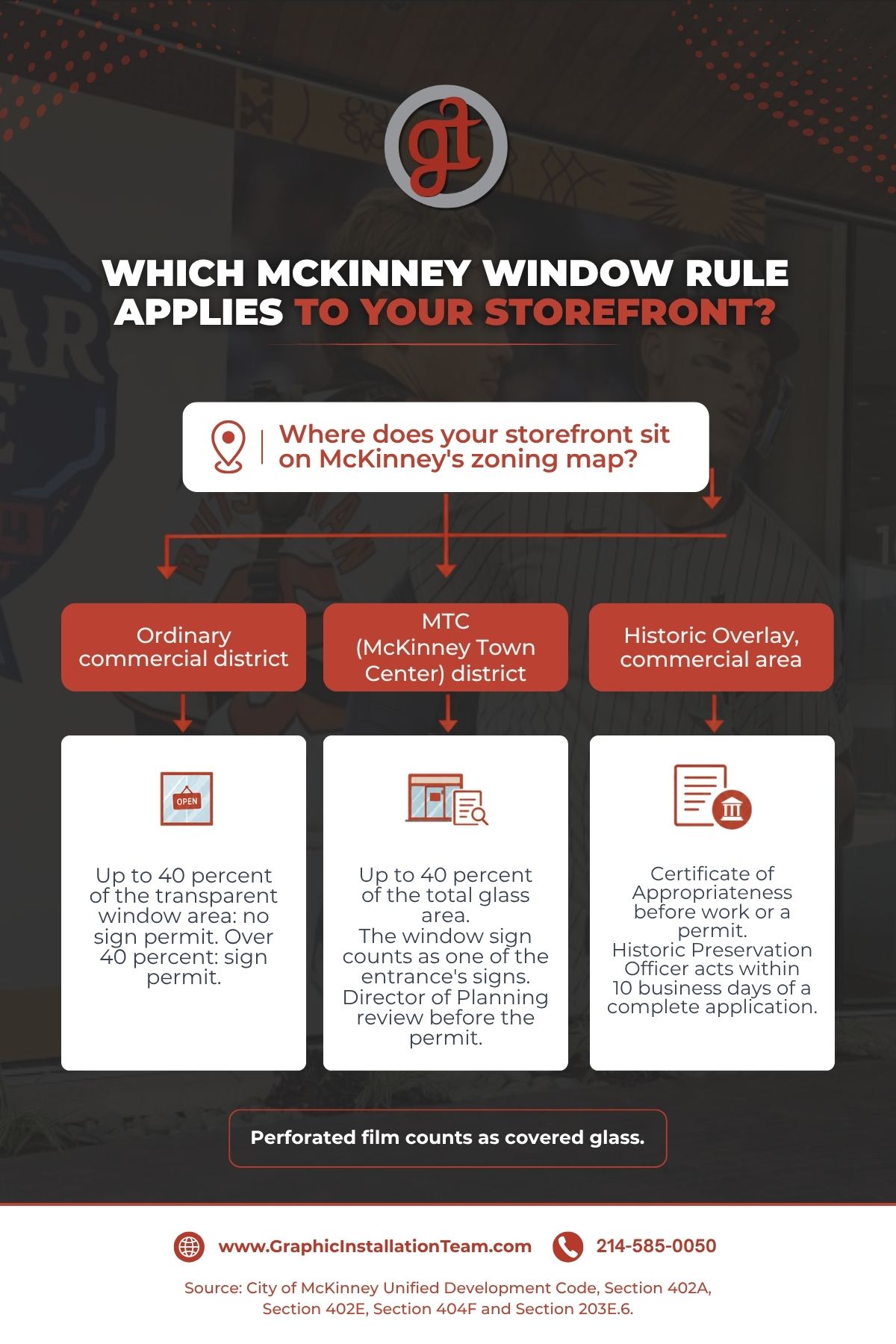
The 40 percent figure appears twice in the sign article, and it does not mean the same thing both times. Where your storefront sits on the city’s zoning map decides which version applies and whether anyone outside Building Inspections has to sign off.
Most of McKinney: the exemption
For a storefront in an ordinary commercial district, the Section 402E exemption is the whole story. Stay at or under 40 percent, and there is no permit, no fee, and no review. Go over, and the graphic follows the normal sign permit path in Section 402A.
Inside the town center (MTC) district
Inside the MTC district, Section 404F sets its own sign rules. Window signs may cover no more than 40 percent of the total glass area, and the code adds that the window sign “will count as one of the signs permitted.” Each primary entrance gets two signs, plus one hanging sign when a canopy is used.
That second clause is where plans go wrong.
A shop with a wall sign and a projecting sign has already used both of its entrance signs, so a window graphic becomes a third. MTC signs are also reviewed by the Director of Planning, and that approval comes before a sign permit is issued.
Storefronts in the historic overlay
Within the commercial area of the Historic Overlay, work on any property visible from the public right-of-way needs a Certificate of Appropriateness before it starts, under Section 203E.6. When the proposal includes signs or lettering, the application carries a scale drawing showing the lettering, every dimension and color, the materials, any lighting, and the location on the building. Section 402A adds that signs in the overlay need that approval before a sign permit can be issued at all.
| Where the storefront sits | Coverage limit on glass | Extra review | Does the window graphic count as a sign? |
|---|---|---|---|
| Ordinary commercial district | 40 percent of transparent window area for the permit exemption | None under the limit | Only once it passes 40 percent |
| MTC district | 40 percent of total glass area | Director of Planning review before the permit | Yes, it uses one of the entrance signs |
| Historic Overlay commercial area | The coverage rule for the underlying district still applies | Certificate of Appropriateness before work or a permit | Treated as exterior work that needs sign-off |
The city keeps the overlay boundaries on its official zoning map. Check the map before assuming a building is in or out, because the answer changes the timeline more than it changes the design.
Is a Window Graphic Always a Sign?
No. McKinney defines a sign as writing, letters, numerals, pictures, emblems, trademarks or designs meant to identify, advertise, announce, or inform. The same definition leaves out three things: works of art that do not identify a product or business and are not shown in connection with a for-profit enterprise, temporary holiday decorations, and official signs from a public agency.
That definition sorts most storefront vinyl quickly. The decorative mural on a coffee shop window is still shown in connection with a for-profit business, so it is hard to argue it out of the count. A frost band with the logo cut into it identifies the business. A plain privacy band with no text or mark is a closer call, and it is exactly the kind of question worth asking before print. We cover the practical side of that line in our piece on how graphic installation differs from sign installation.
Counts toward the 40 percent:
- Logo, business name, or tagline in any film
- Hours, phone number, website or social handles
- Sale, menu or promotional graphics
- Frosted film with lettering or a mark cut into it
- Perforated one-way film carrying an image
Probably does not count:
- Holiday decorations that are temporary and tied to the celebration
- Graphics that cannot be seen from any public right-of-way
- Official notices a public agency requires you to post
The holiday line matters right now. Retail windows in McKinney start turning over for the season in the fall, and a snowflake decal set is treated differently from a half-price banner hung in the same pane.
Measuring the 40 Percent Before Anything Is Printed
Coverage is arithmetic, and it only works when it is done on the real glass, not on a drawing of the building front. Here is how we suggest a business owner or their designer runs it.
- Record the clear glass of each pane, inside the frame, width by height.
- Multiply to get the area of each pane in square feet, then add the panes together.
- Size every piece of vinyl you plan to put on that glass, including small decals.
- Add the vinyl up per pane and in total.
- Compare both numbers against 40 percent.
A worked example shows why step 5 has two parts. Picture a storefront with three panes, each 6 feet wide and 8 feet tall. Each pane is 48 square feet, so the frontage is 144 square feet and 40 percent of it is 57.6 square feet. A full-height graphic on one pane uses 48 square feet, which is under the total, but it covers the whole of that pane.
Neither version of the rule says whether the limit is measured pane by pane or across the whole frontage. The exemption talks about “transparent window area” and the MTC rule about “total glass area.” Keeping every pane at or under 40 percent satisfies both readings, which is the plan we would put money on if a permit, a reprint, and an install date all hang on the answer.
Doors are glass too.
A door with hours, a logo, and a card-acceptance decal can carry more vinyl per square foot than any window on the frontage, and it is the pane people forget to measure.
Does Perforated Film Get Around the Limit?
Not on the code’s wording. The exemption counts the window area that is “occupied,” and perforated window film occupies glass even though people inside can still see out through the holes. Plan perforated film as covered area. If you want to argue the see-through effect should count differently, have that conversation with Building Inspections before the job is printed, not after it is on the window.
The same applies to printed clear film and to frosted film carrying a mark. The material changes how the window looks from inside. It does not change how much of the glass is carrying a message from the street. If you are still choosing between those materials, our guide to perforated, printed and frosted window film options sets out which one suits which job.
| Film | Looks from inside | Counts as occupied glass? |
|---|---|---|
| Perforated one-way film | Mostly see-through | Yes, on the code’s wording |
| Printed clear or opaque film | Blocked or tinted where printed | Yes |
| Cut vinyl lettering | Clear between letters | The lettered area, measured as the sign |
| Frost with a logo | Diffused | Yes, it identifies the business |
Why Old Glass Gets Extra Care in Historic McKinney
Writing on storefront glass is older than any vinyl. The National Park Service’s Preservation Brief 25 on historic signs, written by Michael J. Auer and published in October 1991, records that gold leaf signs and signs painted or etched on glass in windows, doors, and transoms were common on nineteenth-century commercial buildings. The glass was always part of the sign program.
The brief’s advice on new signs for historic buildings reads well next to McKinney’s own process. New signs should respect the size, scale and design of the building, should not cover the features that give it character, and should be attached in a way that does not damage historic material. McKinney’s Certificate of Appropriateness is judged against the Secretary of the Interior’s Standards for Rehabilitation, the same federal standards family the brief comes from.
Vinyl has one real advantage on an old building. It sits on the glass, where a projecting sign bracket has to be fixed into the facade. It still has to be planned, though.
- Transoms: transom glass above the door is often where original lettering sat, and it is visible from across the street. Keep new vinyl off historic lettering.
- Exceptional Historic Signs: McKinney’s code lets the Historic Preservation Advisory Board list signs at least 50 years old that add to the historic character of the area, and listed signs are exempt from the sign article. If your building has one, new graphics should work around it.
- Removal: lifting old film off old glass takes more care than installing new film, and scraping around original gilding is how it gets damaged.
Getting the Order Right on a McKinney Storefront Job
Most window projects that stall in McKinney stall because the steps happened in the wrong order: art approved, film printed, install booked, and only then a question about the permit. Our list of the mistakes that stall a graphics job has a general version. For McKinney window work, this is the sequence.
- Find the district. Check the official zoning map for the MTC district and the Historic Overlay.
- Get the glass measurements, pane by pane, with doors included.
- Sort sign from not-sign. Use the definition, not instinct.
- Get approvals if needed. Historic Overlay jobs start with the Certificate of Appropriateness. MTC jobs go through the Director of Planning review before the permit. Over 40 percent anywhere, a sign permit follows.
- Release the art to print only once the coverage and approvals are settled.
- Book the install, with the permit in hand if one was needed, and within its 90-day window.
The permit fee is not a flat number. Section 402A ties it to the sign’s valuation through the fee schedule in Appendix A of the Code of Ordinances, so the figure depends on the job. The $20,000 insurance minimum in the same section sits with whoever applies, which is why the question of who applies belongs at step 4, not on install morning.
Our crews work out of Anna, in Collin County, north of McKinney. Other Collin County cities write their own sign rules, so the 40 percent figure here is McKinney’s, not a regional standard. We install custom window graphics in McKinney from film your printer or sign shop produces, and the same install-only model runs through our wall and window installation work elsewhere. For a wider look at what a storefront can carry beyond the glass, see the kinds of commercial graphics a business front can use.
Size Up Your McKinney Storefront Glass Before It Goes to Print
Before you send a window design to print, do three things. Check whether your McKinney storefront sits in the MTC district or the Historic Overlay. Get the clear glass dimensions for every pane and door, and keep each one at or under 40 percent if you want to stay inside the permit exemption. Then decide who will apply for any permit or Certificate of Appropriateness the job needs, because that decision carries the insurance requirement with it.
Once those answers are settled, the install is the easy part.
Send us the finished art, the pane measurements and the approvals, and the Graphic Installation Team will schedule the crew around your opening date.
